-
TV Review: Doctor Who S6 E09 – ‘Night Terrors’
Cast: Matt Smith, Karen Gillen, Arthur Darvill, Daniel Mays, Jamie Oram, Emma Cunliffe ~ Writer: Mark Gatiss ~ Director: Richard Clark ~ Year: 2011

[xrr rating=3/5]
The Low-Down: After the time-warping loopiness of ‘Let’s Kill Hitler’, something calmer and more traditional – ‘Night Terrors’ has plenty of flaws, but sharp dialogue, strong atmosphere and another great performance from Matt Smith all steer this episode through to a fine conclusion.
What’s it About?: Summoned by an unexpected call via the Psychic Paper, the TARDIS crew find themselves visiting a dreary tower block, where a young boy is living in a state of permanent fear. Eight-year-old George is convinced that there are monsters lurking in his cupboard, waiting to claim him – and the Doctor is soon discovering that he’s frighteningly correct…
The Story: (WARNING: As with most of my Doctor Who reviews, the following contains a hefty load of spoilers…)
It’s not exactly a surprise that an episode like ‘Night Terrors’ has happened on Steven Moffat’s watch – no other New Who writer has been quite so dedicated to exploring childhood fears in such a specific way, and the only real surprise is that it doesn’t come from Moffat, instead being the fourth New Who episode to be written by prolific actor/writer Mark Gatiss. Considering Gatiss’ run on the show has been a bit on the inconsistent side (going from the quality of ‘The Unquiet Dead’ in S1 to the rushed pacing and garbled storytelling of ‘Victory of the Daleks’ in S5), it would have been easy to be concerned about this episode – but while Night Terrors is far better than his Season 5 outing (or the rather weak S2 episode ‘The Idiot’s Lantern’), it’s a curiously quiet and simple episode that settles for being solid rather than memorable.
Weirdly enough, ‘Night Terrors’ is also a semi-flashback to New Who’s history, with a council estate setting that’s like the grungier, less welcoming flipside to the Powell Estate where this latest incarnation of the show spent so much time. Considering how integral this kind of location used to be to the make-up of the show (especially in S2, where I occasionally felt like Who had transformed into a tour of Council Estates through the ages), it’s a refreshing jolt to find that for Amy and Rory, this is an unusual sight to find on the other side of the TARDIS doors, and shows exactly how much the show has spread its storytelling wings in the last few years.
Of course, much of this grunginess plays into the story of George’s fears (especially Andrew Tiernan as the bullying landlord), and the direction tries as hard as possible to amp up the menace, especially once the action arrives in the shadowy corridors of the dollhouse. It’s been a while since Who has tried this hard to be deliberately spooky, delivering the kind of safe-yet-unsettling child-friendly scares that the programme specialises in (especially in the Jan Svankmajer-inspired scene where the landlord is transformed into a doll), but if there’s an ultimate flaw in ‘Night Terrors’, it’s that it’s a little too deliberate and literal. The story itself is enjoyably presented but surprisingly simple – in a way, the simplicity is a relief after the convoluted histrionics of ‘Let’s Kill Hitler’, but it ends up feeling like such a purposeful exercise in fear that there’s very little to it.
We’re on very literal ground here – plenty of Moffat’s scares in the past have been based on the idea that the monsters children are scared of are real (whether it’s shadows, the creatures under the bed, or something you glimpse out of the corner of your eye), so it’s not exactly a surprise when it turns out that George’s ‘monsters’ are very real. Who works best with layered storytelling, especially when it’s undercutting expectation, and while the “She can’t have kids!” is a tremendously effective revelation, most of the episode runs along very traditional, well-telegraphed lines. It’s a ghost train (a phrase Moffat’s used to describe this whole season), but one that never really feels in danger of being more than an entertainingly spooky spectacle. The mishappen dolls are creepy – but without a specific reason for them to be stalking the corridors of the dollhouse (other than “Well, dolls are creepy”) they’re a surface threat to drive the story, and not much else. (There’s also the simple fact that this is basically a standalone episode with no mention of the overall arc (aside from the slightly clumsy end shot) – it’s because ‘Night Terrors’ was moved from the episode 3 slot, replaced by ‘The Curse of the Black Spot’, but it does end up feeling weird that the seismic revelations of ‘Let’s Kill Hitler’ don’t get any reference at all.)
At the least, the emotional pay-off of the story genuinely works. Once again, we have an episode climax revolving around a father and son bonding where one of them isn’t what they seem, but thankfully this is much more effective than the similar sequence in ‘The Almost People’. It’s a very New Who case of ‘love conquers all’, but one which doesn’t feel like a cheat, partly because the simplicity of the story keeps the focus on the characters. There’s also, of course, the subtext (which I didn’t spot, admittedly, instead first reading it in Adam Roberts’ great review of the episode here and then thinking “Oh, of course…”) that’s possibly the most subtle and effective use of what sometimes gets stupidly referred to as ‘the Gay Agenda’. In short, George is a kid who’s different (but doesn’t quite understand why), and that difference terrifies him to the extent of convincing himself his parents are going to reject him, and it’s only when his father finds out the truth and tells him that he loves him anyway that the crisis in George’s head is resolved. Add to that the fact that he’s hiding everything that scares him in the cupboard/closet (and the presence of a dollhouse, hidden away), and it’s amazing how blatant yet effective the subtext manages to be, hiding in plain sight and not battering the audience over the head with its own significance.
Ultimately, the episode works better as a spooky, dream-like psychodrama that the lead characters just happen to have wandered into, than as the scary thrill-ride it occasionally seems to want to be. There are some nice visual nods to Terry Gilliam’s cult classic kids adventure Time Bandits, while the support performances ride that New Who line between earnest, effective and a little too cartoony. Daniel Mays is mostly excellent with only a couple of weak moments, Jamie Oram does a pretty good job of maintaining a near-constant level of wide-eyed fear throughout the entire episode, and Andrew Tiernan yet again proves he’s the go-to guy for heavy-set and menacing villains.
It’s the leads who really make this episode, however. The kookiness of the Doctor/Amy/Rory team can feel overwhelming in an episode like ‘Let’s Kill Hitler’, and yet here it livens the episode up (with even Amy and Rory feeling slightly alien and out-of-place in this setting), adding colour to the downbeat and grungy world of the council estate. More than anything else, though, Night Terrors once again proves that Matt Smith makes a downright fascinating Doctor, and is arguably at his best when he’s got a relatively mundane setting to play against. There’s something tremendously endearing about the way the Doctor wanders into the lives of George and his father, and Smith controls the leaps from comedy to drama with commendable skill (especially in the “You see these eyes? They’re old eyes” speech). Combined with some great one-liners and enjoyable physical comedy, Smith raises ‘Night Terrors’ up by several degrees, and leaves it as a fun and entertaining episode that’s certainly ahead of this season’s weaker moments, but isn’t likely to linger in the memory.
The Verdict: A solid, modestly enjoyable episode that acts as a good counterpoint to ‘Let’s Kill Hitler’, this isn’t Doctor Who at it’s strongest (and does feature a couple of clunky moments, like the unconvincing ‘dragged into the cupboard’ sequence), but a combination of strong dialogue, charm and an effective emotional through-line leaves ‘Night Terrors’ as a quiet but satisfying example of Who storytelling.
Previous Doctor Who Season 6 Reviews:
S6 Eo7 – ‘A Good Man Goes to War’
S6 E05/E06 – ‘The Rebel Flesh’ / ‘The Almost People’
-
Comics Review: The Week in Comics (7/9/2011): Casanova – Avaritia 1, Morning Glories 12
Reviewer: Saxon Bullock (aka @saxonb)
 CASANOVA – AVARITIA issue 1
Writer: Matt Fraction ~ Artist: Gabriel Ba ~ Publisher: Icon[xrr rating=4/5]
It’s been a long time coming. Fast becoming known as the ‘Velvet Underground’ of indie comics, Casanova is a sprawling, wild and deeply bizarre mix of sci-fi and demented spy thriller that built up a major following when it was first published in a stripped-down, adventurously cheap ‘two-colour’ format back in the mid 2000s. Now, following a full-colour reprint of the first two series, we’ve now got the first brand new Casanova material in years… and it’s unsurprisingly tricky. Matt Fraction’s since risen to fame as one of the biggest new writers at Marvel (especially for his work on The Invincible Iron Man), but Casanova is something different, and weirdly personal in spite of its seemingly too-cool-for-school mix of spies, sex and alternate universes. Everyone involved in Casanova has moved on in one way or another during the ‘hiatus’, so it’s no surprise that this feels different – for a start, we have an uninterrupted 32 page chapter (which also means the price has gone up to $4.99 an issue), and also the storytelling is a little bigger, and not quite as fiercely compressed as before. That isn’t to say Fraction and his team aren’t still experimenting like crazy – there’s a dizzying whirl of techniques here, including seventies-style freeze frame captions, genuinely effective thought balloons, and sixteen different alternate universes on a single page. But with the story much darker, as Casanova finds himself stuck annihilating realities under orders from his ‘father’ (only to then discover something much more significant), this isn’t quite the full-on, no-holds-barred explosion of pure comics that Casanova has managed before. New arc, new theme, new style – I may have been ever-so-slightly disappointed with the first instalment of Avaritia, but I’m willing to give Fraction the benefit of the doubt and settle in for what’s sure to be a wild and unpredictable journey.
 MORNING GLORIES issue 12
Writer: Nick Spencer ~ Artist: Joe Eisma ~ Publisher: Image[xrr rating=2.5/5]
Oh, Morning Glories. You had me. You really did. I was buckled in for the ride – the first six issues hooked me with their mix of Lost, The Prisoner, and the early (best) years of Buffy the Vampire Slayer. You even had Nick Spencer, one of the most promising writers out there, and the man reponsible for the Jimmy Olsen special that was, frankly, close to being the comic of the year. So why exactly did I end reading issue 12 of Morning Glories by deciding that 12 issues, frankly, was quite enough? Honestly, it’s because the second six-issue helping (I hesitate to call it an ‘arc’) started really well, but has ended up leeching all the momentum out of the story. The concept of doing character-centric issues is a good one – it’s very Lost, and it should have given us time to get to know our characters. And it did, in a manner of speaking – but Spencer’s decision to pile mystery on top of mystery has ended up with lots and lots of intrigue, but a glacial storytelling pace that feels like it’s going nowhere.
Added to which, most of the mysteries haven’t been followed up on in the slightest, meaning it’s been rather like reading six issue ones in a row, and I’ve gotten fed up of waiting for the story to start. Lost-style longform storytelling is risky in a monthly comic book format, because you’ve got to give the audience enough meat to feel like they’ve gotten their money’s worth, and with Morning Glories it’s as if I’ve been buying 22 pages of tease for the past few months. Even issue 12 (which features some strong moments, seriously intriguing reveals and a couple of big revelations) still manages to introduce another new character and a whole selection of other things we don’t have answers for, and the results are more frustrating than entertaining. Added to this, there’s Spencer’s occasional moments of dialogue clunk, particularly when someone decides to say something significant in bold and italics for extra emphasis in case we hadn’t gotten the message that this was important… and then there’s the art. I’ve given artist Joe Eisma twelve issues to convince me, and his line-heavy, slightly bare style simply hasn’t won me over, while it’d be nice if he could draw more than one female character (Scarlet) who doesn’t have the same face as everybody else. It’s a real shame – Morning Glories has tons of potential, and properly entertained me for its first six issues, but right now I’m leaving this high school thriller to it. I’ll check in once the third arc is out in trade, but for now, Morning Glories is on its own.
-
Comics Review: The DC New 52, Week 2 – Action Comics, Animal Man, Batgirl, Batwing, Detective Comics, Green Arrow, Hawk and Dove, Justice League International, Men of War, O.M.A.C., Static Shock, Stormwatch, Swamp Thing
Reviewer: Saxon Bullock (aka @saxonb)
 ACTION COMICS issue 1
Writer: Grant Morrison ~ Artists: Rags Morales ~ Price: $3.99 ~[xrr rating=4.5/5]
A manic, hyper-energised rush of a comic, this is Grant Morrison in full-on superhero blockbuster mode, and certainly one of the most outright entertaining comics of the New 52 so far. Action Comics is also a take on Superman that hasn’t really be seen since the early 1940s – the Man of Steel as a young bruiser and social crusader, standing up to the corrupt in Metropolis while also trying to figure out his gradually growing powers (this is a Superman who hasn’t mastered flight as yet). Simultaneously modern and retro, this is lively comic-book storytelling that throws in plenty of wit and some glorious in-jokes (like the Smallville-referencing “Somebody, SAVE ME!” dialogue on the first major splash page), while also being the best Superman comic in a very long time. Superman was the one piece of the DCU that needed an update more than anyone else, and so far it looks like this relatively radical take is absolutely going to pay off.
 ANIMAL MAN issue 1
Writer: Jeff Lemire ~ Artist: Travel Foreman ~ Price: $2.99[xrr rating=3.5/5]
Starting off with a pretty daring opening page (an interview with the character, presented as a wall of text), Animal Man is one of the more adventurous new DC titles, which perfectly fits with the title’s more adventurous and experimental history. This is much more in the realm of the Vertigo era of Animal Man than the self-referential Grant Morrison era, and while Buddy Baker may be a very grounded example of a superhero (especially since he’s one of the few allowed a proper family), this story’s obviously going to be pushing him in some seriously bizarre directions. Jeff Lemire’s script is atmospheric and well-executed – the art, on the other hand, will take some getting used to, feeling more at ease with the weirder elements than it does with the traditional dialogue (especially with the occasional distorted faces). Nevertheless, it does start off the weirder edges of the new DC Universe, as well as hinting at some deeply disturbing stuff to come…
 BATGIRL issue 1
Writer: Gail Simone ~ Artist: Ardian Syaf and Vicente Cifuentes ~ Price: $2.99[xrr rating=4/5]
This was the one real problem I had with the new DC setup – the fact that they were bringing the previously paralysed Barbara Gordon, who’d spent years as computer info-expert Oracle, back as Batgirl – but trust Gail Simone, one of the best and most consistent mainstream superhero writers, to dispel all my fears. Batgirl #1 is a really sharp, well-executed comic, and Simone gives Barbara a very distinctive voice that’s a mixture of cocky adventurousness and genuinely understandable fear. The previous history of Batgirl (and especially the attack from the Joker which caused her paralysis) is an integral part of the story, and Simone packs this full of value, with good character moments and strong storytelling. It’s occasionally let down by a couple of moments of awkward visuals, but otherwise this is damn good fun and one of the highlights of the new DC Universe so far.
 BATWING issue 1
Writer: Judd Winick ~ Artist: Ben Oliver ~ Price: $2.99[xrr rating=2/5]
A pretty new character briefly introduced in recent issues of Batman Incorporated, the idea of an African spin on Batman is certainly interesting, but Batwing doesn’t quite manage to make it all work. Judd Winick’s script does pull off a couple of well-played moments, and there’s fragments of a good story here (along with a promising central character), but the cliffhanger comes at a very odd moment, and there’s a slight overreliance on gory shock tactics. Plus, the art may have plenty of texture and atmosphere, but it also manages to completely leave out any backgrounds, meaning this is an African-set comic where we never actually get to see Africa. Combine that with massive panels populated by tiny word baloons, and Batwing ends up as a very threadbare, empty-feeling comic that’s over before it’s properly begun.
 DETECTIVE COMICS issue 1
Writer: Tony S. Daniel ~ Artist: Tony S. Daniel and Ryan Winn ~ Price: $2.99[xrr rating=4/5]
I’d heard mixed things about Tony Daniel (or, as he now likes to call himself, Tony Salvador Daniel) and his previous run writing and drawing Batman, but this first issue of the relaunched Detective Comics (which, like Action Comics, renumbers a title that had previously been going uninterrupted for over 70 years) is surprisingly good stuff. There’s a lot here that’s traditional and expected – anyone wanting a gritty tale of Batman on the streets of Gotham battling a grotesquely violent Joker will find plenty to enjoy, while also setting up the new Gotham-based status quo in a brisk fashion. Daniel’s take on the Joker is good without being classic, but it’s all well-executed, muscular superhero comics – until we get to the ending, which is an absolute, out-of-nowhere “Did they seriously just do that?” moment. One of the most enjoyable things about monthly comics are when they get the cliffhangers right, with endings that simply demand that you read the next instalment, and Detective Comics – a title I wasn’t even expecting to be that good – has made me seriously keen to discover what happens next…
 GREEN ARROW issue 1
Writer: J.T. Krul ~ Artist: Dan Jurgens and George Perez ~ Price: $2.99[xrr rating=1.5/5]
Oh dear. Remixing Green Arrow as a freewheeling corporate tycoon who moonlights as a Robin Hood-style vigilante is a fun idea, but did it have to feel quite so much like the pilot episode to a rather poor superhero TV series circa 1987? A combination of weak dialogue and the ultra-traditional art of Dan Jurgens and George Perez leaves this whole issue feeling rather lifeless, and propped up with the tired device of superheroes fighting supervillains simply for the sake of it. A couple of good moments and some funky trick arrows doesn’t make a decent comic, and Green Arrow feels locked in the past rather than something that should have been looking to the future.
 HAWK AND DOVE issue 1
Writer: Sterling Gates ~ Artist: Rob Liefeld ~ Price: $2.99[xrr rating=2.5/5]
Speaking of the past… we have the return of Rob Liefeld, the comic artist superstar with the ‘questionable’ attitude to anatomy, who bestrode the Nineties comics world like a colossus (or, at least, a colossus who really didn’t like to draw character’s feet). Hawk & Dove, following the adventures of (believe it or not) the Avatars of War and Peace, is a comic that’s so ridiculously Nineties it should come with a health warning. There’s plenty of energy here, alongside some absurdly overblown melodrama (and the expected moments of weird, impossible anatomy), but this is certainly one bit of the relaunch that isn’t aiming at anyone but longtime comics fanboys. I certainly can’t think of anyone else who’ll get anything out of such a ridiculous, over-the-top and dated concept – despite a couple of mildly exciting sequences, this one doesn’t really get out of first gear.
 JUSTICE LEAGUE INTERNATIONAL issue 1
Writer: Dan Jurgens ~ Artist: Aaron Lopresti and Matt Ryan ~ Price: $2.99[xrr rating=4/5]
Another fanboy-aimed title, this DC adventure aims to recapture the spirit of the more comedy-oriented JLI, and goes about its business with an enjoyable sense of fun. Justice League International is the first of the mainstream ‘middle-of-the-road’ DC titles to actually feel like it’s working, bringing together a team of mismatched characters to tackle international threats to the globe (and doing it a lot more briskly and more enjoyably than Geoff Johns’ Justice League). Dan Jurgens is a very old-fashioned writer, but this gets the mix just about right, and the end result is a comic that’s in no way exceptional, but which delivers enough old school fun and entertainment that the reader doesn’t really mind.
 MEN OF WAR issue 1
Writer: Ivan Brandon ~ Artist: Tom Derenick ~ Price: $2.99[xrr rating=2.5/5]
An interesting idea – the life of traditional soldiers in the DC Universe – gets an execution that doesn’t always live up to its potential. Essentially an update of the classic, long-running 1940s -set Sgt. Rock comics (here starring Rock’s grandson), Men of War pulls off some very strong moments, especially the way it captures superheroes as a dangerously lethal force-of-nature. Trouble is, the visual storytelling is sometimes a little stiff and the art doesn’t always have the life it needs. It also doesn’t help that the back-up strip (a completely non-genre war story, so far) is, despite being shorter, a lot stronger and more effective. It’s good to see DC trying a variety of styles and executions, but unless this improves drastically, I can’t see it living very long.
 O.M.A.C. issue 1
Writer: Dan Didio and Keith Giffen ~ Artist: Keith Giffen and Scott Koblish ~ Price: $2.99[xrr rating=5/5]
Oh yes. Deliriously nutty, colourful and intensely visual, O.M.A.C. is the most deliberate pastiche to Jack Kirby that I’ve seen for a while, and is also a tremendous amount of fun. Perfectly capturing the Kirby mix of energy, fizz and out-of-nowhere strangeness, this updated, retooled version of the O.M.A.C. concept packs in a tremendous amount of action, while the art (by both Giffen and DiDio) pulls off ludicrous visuals with tremendous style. It’s hard to know what non Kirby-fans will think of this, but the mix of sheer comic book pizzazz is so giddy that hopefully others will be swept along by O.M.A.C.’s infectiously lurid insanity. One of the most deliberately loopy of the new DC titles, and also one of the most enjoyable, O.M.A.C. is a must-read for any lovers of comic-book strangeness.
 STATIC SHOCK issue 1
Writer: Scott McDaniel and John Rozum ~ Artist: Scott McDaniel, Jonathan Glapion, LaBeau Underwood ~ Price: $2.99[xrr rating=2.5/5]
Originally part of the ‘Milestone’ universe created by the late Dwayne McDuffie, in Static Shock we basically have a fun, lively if not-exactly-revolutionary Spider-Man-style teen comic, with art that’s tremendously energetic but doesn’t always keep things coherent. The story throws in some fun setups, and once we get into the second half of the issue things start to pull together. However, the whole thing once again feels very Nineties in approach and execution, and while the central character does pull off some fun and charming moments, overall Static Shock doesn’t escape the feeling that we’ve seen all this before.
 STORMWATCH issue 1
Writer: Paul Cornell ~ Artist: Miguel Sepulveda ~ Price: $2.99[xrr rating=3.5/5]
This was always going to be tricky – a relaunch of a long-running, well-known title that essentially launched Warren Ellis’ career, and which takes the controversial core team from Wildstorm comics (better known as the Authority) and drops them down in the DC Universe. Considering that two members of this team are, essentially, a gay version of both Superman and Batman (here known as Apollo and the Midnighter), this was certainly a risky and intriguing move by DC, and what we get is Stormwatch, a comic that’s big, bold and energetic, even if it (understandably) can’t live up to the title’s long, complicated and controversy-heavy history. For newcomers, Stormwatch are the people in the shadows, who’ve been looking after the DC Universe for much longer than these newly arrived cape-wearing wannabes, and Cornell pulls off some great cinematic moments here, while introducing a bizarre and intriguing threat. The character interplay is well-executed and often fun, but it’s also sometimes dragged down by Sepulveda’s art, which feels a little too stiff and doesn’t give the story the right level of visual impact (especially in the final splash page). There’s room for growth and improvement, but this is a promising beginning…
 SWAMP THING issue 1
Writer: Scott Snyder ~ Artist: Yanick Paquette ~ Price: $2.99[xrr rating=5/5]
One of the most visually impressive of all the DC Universe titles, Swamp Thing also sees writer Scott Snyder taking on a difficult character who’s seen multiple versions and relaunches (most famously, in a classic run by Alan Moore that essentially redefined what mainstream comics can do), and finding a unique take that has its own sense of identity and purpose. Snyder’s execution here is pretty much faultless, giving us strong characterisation and some graphically nasty horror, while also placing this new version of Swamp Thing firmly down in the DC Universe, with the sequences featuring Superman being among the issue’s best. Matched brilliantly by Yanick Paquette’s gorgeous, textured artwork, this is atmospheric dark fantasy that’s stylishly mounted and brilliantly done, pointing in some very intriguing directions. It’s hard to say if Snyder’s run is going to live up to this character’s very weighty history, but he’s certainly off to an excellent start.
Previous Reviews:
-
Book Review: Prince of Thorns
Author: Mark Lawrence ~ Length: 373 pp ~
Publisher: HarperCollins Voyager ~ Year: 2011 Reviewer: Laure Eve (aka @LaureEve)
The Low-Down: A younger, snappier twist on the epic fantasy game, Prince of Thorns may not rock your world, but it’s still an impressive work from a debut author, and marks the arrival of a gutsy new talent on the fantasy scene.
What’s it About?: Prince Jorg of Ancrath, young heir to one throne of many in a brutal and broken kingdom, spends his time raping, pillaging, and brooding over the day his mother and younger brother were murdered in front of him. But as he moves through his determined and bloody journey to become emperor over all, is he really in control of his savage destiny, or is someone else pulling the strings?
The Story: Things are full steam ahead for epic fantasy at the moment. Sean Bean’s craggy grim face and Northern twang dominated screens very recently in HBO’s A Game of Thrones and George R. R. Martin is now a name pinging recognition in even mainstream critics’ brains. And good thing too, because of all fantasy genres, sword and sorcery is the one in most danger of stagnation. It’s hard to innovate when the setting and environment are in general so rigidly structured, so hats off to a debut author having a pretty decent stab at it. If you’re looking for originality in your epic fantasy, don’t let the one-size-fits-all cover of Prince of Thorns put you off. The appearence of yet another mysterious cloaked figure may just be enough to make the eyes of a large swathe of readers roll and look elsewhere, but try this out for size– you’ll be pleasantly surprised.
The thing that has gotten people all abuzz over this book is the controversial angle of having a young protagonist who seems right from the off to be a psychopathic bastard. He gets the urge to kill people in the same way others might have a sudden, biting need for sugary confection. It’s an immediately intriguing set-up and one that really drives the narrative forward: why is he this way? Why is he this way at fourteen?
Perversely, the worse Jorg acts, the more interested you become in him and his ultimate purpose in life. It’s a hard trick to pull off, persuading the reader to care about a truly nasty protagonist, and it’s one that Lawrence tackles well, raising that most fascinating of debates over nature and nurture. Perhaps it’s understandable why someone could become such a cold, broken killer when it’s revealed what happened to him as a child, but it’s also true that people make choices; where one person is horribly wronged and turns sadistic murderer to cope with his scars, another, with the same experiences on his soul, would never even dream of raising a hand to a dog. How much choice do you have if you’re born into such a violent, uncompromising environment as Jorg is, with a father who seems to have a large, sucking hole where his heart should be?
The second thing that really lifts this book out of the ordinary masses is the prose itself. Lawrence has a way with words – at turns funny, cruel, sharply witty and downright lyrical, his turn of phrase keeps you locked right in. This is spare storytelling and no mistake, but words are used in just the right way. From the casual, morbid poetry of the opening paragraphs to the resolute, aggressive set up line for the next book at the very end, this is a writer confident with both voice and language. Jorg in particular has a great tone, his witticisms tinged with the faintest air of Alex from A Clockwork Orange.
This isn’t a perfect work, however, and the structure in particular feels pedestrian. A scene at one location happens; a new chapter starts; lo, we are at another location. At times it feels as if the story moves on in stiff jerks, with no time for the reader to absorb and pause with the characters. Keeping it fast and jagged, reflecting the nature of both the people and the world, is one thing; having no sense of journey, and thus no sense of achievement or even believability in the extraordinary things Jorg does is another.
Makin is another puzzle. Makin is Jorg’s supposed best friend – a knight, and clearly a man with a strong moral code. Why does he pad around after Jorg like a faithful dog? What drives him? Sometimes it’s plain that he doesn’t like or approve of Jorg’s behaviour, though you suppose he may be able to understand where it comes from. At other times, the moment he is first introduced in fact, he seems to enjoy the rape and pillage as much as the worst of Jorg’s motley ‘road brothers’. We’re shown Makin has a strong sense of honour, but then he continually disproves it with his actions. He isn’t clearly written as a conflicted character, so unfortunately this comes across as jarring. However, it is clear that his story is very much in the middle, so perhaps we’ll see a more clearly drawn picture of him in the books to come.
Now to magic. There’s plenty of the stuff in Prince of Thorns, and a recognisably distrustful view of those who wield it. Magic in this world is for weird, powerful figures with secretive end games and twisted agendas. Set in conjunction to this, and fascinatingly so, is the history of the world itself. Small nuggets of clues are dropped, and no more – thankfully, there is no ponderous exposition to tackle. It’s nice and light, but unmistakable in its intentions. Without getting too spoiler-tastic, the time and place of this world is important, and when taking into consideration the existence of magic in this setting, things start to get very interesting.
Lawrence has created a world that feels, for the most part, real and dark and dripping with Shakespearian intrigue. The short, vibrant prose makes it young and fresh, and in Prince Jorg the book gives us the rare gift of a conflicted, damaged protagonist who you end up rooting for, even if you then feel a bit odd about doing so.
The Verdict: Some haphazard pacing and too much character work left hanging make this less than perfect, but overall Prince of Thorns is a short, sharp shock of epic fantasy and a really impressive debut.
[amtap book:isbn=0007423292]
-
Comics Review: The Week in Comics (31/08/11) – Flashpoint #5, Locke and Key: Clockworks #2, Secret Avengers #16, Angel & Faith #1
Reviewer: Saxon Bullock (aka @saxonb)
 FLASHPOINT issue 5
Writer: Geoff Johns ~ Artist: Andy Kubert ~ Publisher: DC ComicsHard as it is to believe, there were other comics than Justice League #1 published this week – like Flashpoint #5, the finale to the timeline-altering crossover miniseries which has never quite managed to be as interesting as all the tie-in Elseworld-style action going on around it. Naturally, it all comes down to family, and Geoff Johns ends the story in a way that will surprise nobody who’s ever seen a ‘Dangers of altering time’ tale, but does at least provide the right levels of colourful melodrama. It’s an average comic that doesn’t really deserve the weight of being the final comic published by DC as part of the ‘regular’ universe (although the big change happens here) – Flashpoint #5 isn’t actually bad, but it also isn’t quite the world-shattering conclusion that we might have expected, even if the often-used promise that ‘things will never be the same again’ does at least seem to be partially true now…
[xrr rating=3/5]
 LOCKE AND KEY: CLOCKWORKS issue 2
Writer: Joe Hill ~ Artists: Gabriel Rodriguez ~ Publisher: IDW ComicsAnother Locke and Key issue, another home run, and another example of what’s probably the most consistent and inventive comic currently being published. It’s a kooky, deliriously twisted mix of dark fantasy, emotional drama and outright horror that’s continuing to excel – this is one of the quieter instalments, but one which builds to a powerful finale, as Hill starts pulling all the storytelling strands together. There’s still time for some gorgeous visual moments and off-kilter wit, while one particular revelation arrives a hell of lot sooner than I expected. There’s only ten issues of the overall story left following this, and while I don’t know where Hill is taking the characters, I’m sure it’s going to be (a) traumatic and (b) unmissable.
[xrr rating=5/5]
 SECRET AVENGERS issue 16
Writer: Warren Ellis ~ Artists: Jamie McKelvie, Matthew Wilson ~ Publisher: MarvelNow, that’s the kind of creative team that gets me reading a comic simply to see what they’ll do, and it doesn’t disappoint. Ellis does fast, whip-smart action combined with sarcastic one-liners better than anyone, and combine that with Jamie McKelvie’s clean, crisp artwork and you’ve got a witty, wild and hugely entertaining romp. Okay, I barely had an idea of what had gone before in the series (which follows Steve Rogers and various other characters on ‘black ops’-style missions), but by the end of it I was having so much fun that I didn’t care. Worth it, simply for lines like: “Relax. I’m too borderline psychotic to feel pain.”
[xrr rating=4/5]
 ANGEL & FAITH issue 1
Writer: Christos Gage ~ Artist: Rebekah Isaacs ~ Publisher: Dark HorseBiggest surprise of the week was how much I enjoyed this – the first issue in the next phase of Buffy the Vampire Slayer’s comics-bound afterlife. The 40-issue long Buffy Season 8 was fun in parts, but arguably got out of control and certainly went on a bit too long; now that Dark Horse has the rights to Angel back from IDW comics, they’re now going to be running parallel series dealing with the new Buffyverse reality, where the world’s been sealed off from magic (thanks to Buffy’s actions at the end of season 8), and where Angel is now having to deal with the repercussions of his actions as Twilight, including the murder (while he was possessed) of longtime character and ex-Watcher Rupert Giles. Briskly written, entertaining and packing a hell of a lot into its 22 pages, this is everything you’d want from a spin-off comic, while the art from Rebekah Isaacs carefully rides the line between cartoony and capturing decent likenesses of the cast. It’s no classic, but it does look like this latest arrival from the Buffyverse is going to be worth keeping up with…
-
Comics Review: The DC New 52, Week One – Justice League #1
Writer: Geoff Johns ~ Artists: Jim Lee, Scott Williams ~ Publisher: DC Comics ~
Price: $3.99 ~ Buy it in digital format from Comixology.com [xrr rating=3.5/5]
Reviewer: Saxon Bullock (aka @saxonb)
So – after all the hype, and all the build-up, it actually starts here. The ground-up remix of the New DC Universe has officially begun, and the comic that kicks it all off is Justice League issue 1 (one of only two comics published by DC last week, a ridiculously rare occurrence). The whole aim with this is to (except in a few cases) make the continuity accessible, and provide an easy jumping-on point for an entire superhero universe. People have been saying that it’s either going to save comics, or it’s the beginning of the end – either way, there’s an awful lot riding on this experiment, and Justice League is going to be one of the heavy-hitters of the new DCU, whether people love it or hate it.
And issue one? Well… it’s actually not bad, and rather enjoyable in places. Not being the world’s biggest fan of either writer Geoff Johns or artist Jim Lee (who, at the moment, are basically the two biggest names at DC Comics), I knew from the start I was unlikely to love Justice League. As it is, they’ve given this first issue a very cinematic feel – the visuals are sharp and well-crafted, and there’s some very nice imaginative touches (especially in the use of the Green Lantern ring constructs). This first arc of Justice League is going to be a ‘getting the team together’ story, especially since this story is set five years before the new ‘present’ of the DC Universe – this is a world where the first superhero, Superman, has only recently appeared (a story that’s going to start in next week’s Action Comics), so currently there’s a rather Marvel-style mix of wonder and fear about all these new costumed vigilantes that are popping up. So, we’re very much heading down a ‘heroes in a world that doesn’t trust them who need to find a way of working together for the common good’ path – we know pretty much where this road’s going to take us, it’s all about how good the journey’s going to be.
And so far, the journey looks like it’s going to be fun, if not quite remarkable. As one of DC’s core titles, this really does have to be an appeal-to-everyone blockbuster, so I wasn’t expecting narrative fireworks. Johns is a very reliable writer – he’s going to give you exactly what you expect (solid storytelling, a few well-placed dialogue zingers, some very literal plotting) and not much more. Here, he gives us Batman and Green Lantern on the run, going up against mysterious cybernetic aliens with a very specific (but shadowy) agenda, leading up to a cliffhanger which introduces us to the next member of the line-up.
That’s one of the biggest caveats for this comic’s approach – I can understand taking the slow-burn approach, especially in terms of decompressed storytelling and not overwhelming readers who possibly haven’t read a comic in a very long time. But it does feel might strange to pick up a Justice League comic with the whole team on the cover, and only have half of them show up in the story (one of whom, Vic Stone, hasn’t even been transformed into Cyborg yet). I get the principle of starting with your most recognisable heroes, but it does make things feel a little skewed.
Added to this, there’s the fact that while this does feel very modern and sharp, it’s very much going for a heavy visual feel, with lots of splash pages and minimal panels, meaning the end result does feel a bit sparse. This isn’t a self-contained chapter in the slightest – this is the equivalent of the first ten minutes of a summer blockbuster, and while general comics readers are perfectly happy with comics that are very clearly ‘written for trade’, I was hoping the new DCU would skew slightly more towards making the issues as satisfying as possible, considering that’s what DC are betting the farm on.
The other factor to the visuals is that this is one of the first comics I’ve seen where, for most of the pages, it feels very much structured to work digitally. The panels are laid out in a way that most of them will very comfortably fit on the iPhone/iPad screen – many of the pages are only made up of about three panels, laid out in a widescreen manner, and it looks good, but it does also mean that the comics storytelling isn’t especially adventurous, or even that exciting. The ‘panel by panel’ approach in digital does sometimes reduce the comics storytelling down to feeling like a slideshow, and that’s what the print version of Justice League occasionally feels like – a weird first step down a road where comics are thought out first for digital, and second for print. (It’s worrying to me, as a long-time comics fan, simply because it’d be very easy for even more comics storytelling devices to be ‘bred out’ of mainstream comics, in order so that they can fit better into the digital world, when it’s the adventurous and ‘do anything’ nature of comics that excites me about them).
But then, Justice League isn’t aimed at me. It’s aiming wide, and so far seems like an exciting, fun and engaging start to the DCU, if one that’s a long way from being revolutionary. There’s only a small level of cheesy dialogue, and there’s plenty of fun to be had in Johns’ take on Batman, as well as the general entertainment of watching them building a superhero universe from first principles. It ain’t a classic, and could have been a hell of a lot ballsier than it is, but Justice League #1 ain’t a bad start to this brave new world of superhero comics…
-
TV Review: Doctor Who S6 E08 – ‘Let’s Kill Hitler’
Cast: Matt Smith, Karen Gillen, Arthur Darvill, Alex Kingston, Albert Welling, Nina Toussaint-White ~ Writer: Steven Moffat ~ Director: Richard Senior ~ Year: 2011
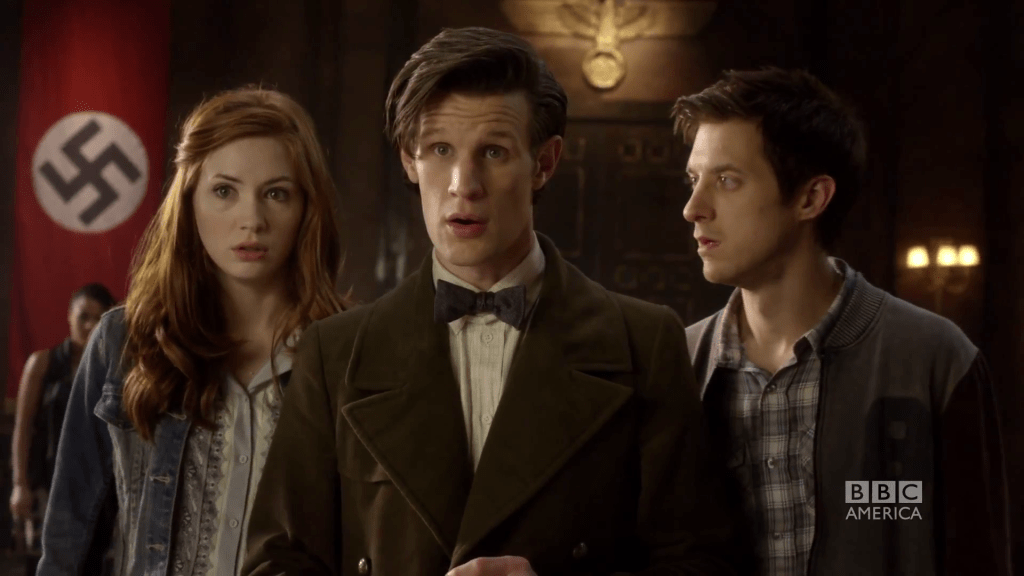
[xrr rating=2.5/5]
The Low-Down: You certainly can’t accuse Doctor Who of not coming back with a bang. ‘Let’s Kill Hitler’ is many things – fast-paced, imaginative, deeply nutty and at times very funny. The only thing it isn’t, though, is satisfying, and this latest batch of episodes looks set to continue being highly divisive…
What’s it About?: Months have gone by, but the Doctor still hasn’t succeeded in tracking down the missing Melody Pond, who’ll eventually grow up to become enigmatic archeologist River Song. Then, however, an encounter with one of Amy and Rory’s friends results in an unexpected trip to 1938 Berlin, and a confrontation with Adolf Hitler that’ll reveal some exceptionally bizarre truths…
The Story: (WARNING: As with most of my Doctor Who reviews, the following contains a hefty load of spoilers…)
As the credits rolled on ‘Let’s Kill Hitler’, I experienced a very unfamiliar feeling. I’d felt it before, quite a few times during Russell T. Davies’s run on Doctor Who, and I’ve already felt it often during Steven Moffat’s ambitious but far from perfect run on Who so far… but this was the first time I’d felt it following one of Moffat’s own episodes: actual, genuine, no-holds-barred disappointment.
Yes, despite the largely positive reception the episode seemed to get online (including some absolutely gushing reviews from people like SFX), I found myself scratching my head and actually realising “Oh dear, I don’t think I enjoyed that…” At first, I wasn’t even certain why – it’s not as if ‘Let’s Kill Hitler’ doesn’t feature a ton of fun and enjoyable elements, or that it isn’t also crammed to bursting with some genuinely excellent dialogue. There are daring concepts, imaginative touches, and at least one storytelling gambit which (despite earlier reservations) did impress the hell out of me. And yet, by the end of it I was perplexed, baffled, and ever-so-slightly vexxed, which certainly wasn’t the reaction I was looking for.
I suspect this is partly because, in going for his most deliberately comic episode ever, Moffat’s actually crafted the closest he’s ever managed to a genuine RTD crowd-pleasing episode – with all the flaws and annoyances that come with that concept. This is very much a “Look at all the STUFF!” episode that’s absolutely determined to batter the audience down with how entertaining it’s going to be, but also suffers from some wild tonal changes, occasionally clunky dialogue (especially from River Song) and a general feeling that we’re watching lots of fascinating ideas thrown together in a heap rather than an actual story. Moffat’s storytelling often revolves around finding interesting and unusual ways of wrong-footing the viewer and subverting expectations, but ‘Let’s Kill Hitler’ is so busy subverting expectations that it never seems to actually stand still long enough to engage as a story. Instead, of being a story, it’s a romp – a chance for the regulars to run around 1938 Berlin shouting at each other, without any real sense of progress or threat (except from the Teselector Antibodies – and, oh dear oh dear, whoever decided to do mechanical jellyfish tentacles should feel very apologetic, as the ‘menacing light-fitting’ attack was some of the least-impressive practical effects I’ve seen on New Who).
Of course, some of this is simply the weight of expectation, as well as the weight of the ongoing story. Moffat has said that the River Song storyline is going to get wrapped up this season (although how conclusively it does this is something we’ll have to see), and this is a very good thing, as the big arc this season has only been intermittently succesful. Many people have waved the ‘Too complicated for kids’ flag, which is nonsense – I have nothing against complicated, but I do have issues with unsatisfying, and that’s what Who is in danger of turning into. The overreaching arc since The Impossible Astronaut (and, in part, since The Pandorica Opens/The Big Bang) has gotten insanely twisty and complex – comparisons have been made with Lost, but what Doctor Who is actually in danger of turning into is the modern version of Battlestar Galactica, at least in terms of the central overarching ‘mystery’. In the same way that the Cylon’s ‘plan’ and the general approach of what in the Galactica universe passes for ‘God’ ended up feeling like a loose excuse to string together a series of unconnected and improvised plot concepts, the current Who arc is so determinedly abstract that we’re eight episodes into this season and we can still only barely explain anything of what’s happening – and so much of what has happened can seemingly be summed up by simply saying “Well… Because! That’s why!”
‘Let’s Kill Hitler’ doesn’t function at all as a self-contained story – it’s part of a sprawling arc, but the arc itself is failing to be satisfying for the simple reason that we don’t know what’s going on. We do know that the Doctor is destined to die at the hands of the Impossible Astronaut, and that River is actually Amy’s daughter, and that she was created and programmed in order to be a weapon for killing the Doctor. We don’t know why any of this is happening (and, most frustratingly, nobody onscreen is actually asking). We don’t know why anyone would go to these kinds of insane lengths (like apparently detonating the entire universe in order to contrive the creation of a new Time Lord child) in order to create a plan with so many variables, and yet which currently seems to come down to “Get a psychopath with poison lipstick to kiss the Doctor”. Considering how many people he’s already kissed in New Who, it makes you wonder why they bothered going so complicated…
(Quick theory time: There is a possibility that the events of ‘Let’s Kill Hitler’ happen because Melody/Mells escaped from the Silence with some of her mental programming still intact – she’s trying to kill the Doctor in this episode without realising that (as I suspect) she’s already done it, back when she was a child in the Astronaut suit. It’s the best explanation I can think of to solve certain problems – although it doesn’t explain what the Astronaut’s doing in 2011, or why River knows why she’s locked in the Storm Cage facility for and yet doesn’t seem to remember the events surrounding the Impossible Astronaut. (It’s possible she’s lying in that episode, of course, but it’s one hell of a cop-out). I am really hoping it doesn’t turn out to be yet another temporal loop-style “Oh, it happened that way because the Doctor knew the future and so made sure it would look that way” in the same way that River Song only becomes River Song because she’s told about herself. And yet, it wouldn’t completely surprise me…)
There’s a difference between mystery and obfuscation, and after a while the deliberate holding back of details (and the twisting complicatedness of the details we are given) starts feeling like being complex simply for it’s own sake. Like with last year’s finale, it’s the spectacle of concepts, rather than visuals – it’s IDEA! IDEA! IDEA! but the arc isn’t supporting it, and is tremendously difficult to relate to. Amy and Rory’s story arc should be taking them to some very dark places, but Moffat seems to want to throw difficult ideas in (like Melody’s abduction) and then just gloss over the consequences – most especially, in the case of Mells.
If there’s one aspect of this episode that fully displays the weird disconnect between sheer narrative ballsiness and dissastisfaction I experienced, it’s the character of Mells. On one hand, it’s a daring bit of writing, and the reveal of the regeneration (and her identity) did at least seem to justify the way she’d been crowbarred into the overarching story in a not-especially convincing way. But, for a writer whose main talent has been structure and forward planning, the way Moffatt has done this is downright bizarre – after all, there would have been plenty of opportunities to set Mells up as a character earlier, or at least vaguely mention her beforehand, instead of simply going “Oh yes, there’s this character we never mentioned before who’s one of our best childhood friends and who was constantly obsessing about the Doctor equal to (or even bigger than) Amy, and OH CRAP she’s got a gun!” It’s so ridiculously quick that it’s very difficult to swallow (and certainly doesn’t feel like good storytelling) – and it’s one of the elements where I honestly feel that ‘Let’s Kill Hitler’ would have worked much better as a two-parter. If we’d had at least an episode to get to know Mells, she wouldn’t have felt quite so much like a comedy sexed-up bad girl thrown in for no other reason to get the plot moving in a very contrived way – as it is, we’ve barely registered her before she’s shot in the gut and then Alex Kingston is unwisely allowed to go rather over-the-top as the newly-born River Song.
(As a complete aside – I actually spent the entirety of ‘A Good Man Goes to War’ utterly convinced that Lorna Bucket, the mysterious ‘Amy Pond that wasn’t’ girl, was going to turn out to be River Song – that she’d die in the end, and regenerate. I was so convinced that I was genuinely nonplussed when it turned out she wasn’t, and I’m left suspecting that this actually would have been much better (and more satisfying) than the revelation we ultimately got).
On top of this, there’s the head-spinning logistics of it all – how did Mells/Melody get from late Sixties New York to Mid/late Nineties Leadworth? Why did she feel the need to hang out with her parents in secret while growing up? I presume Mells had parents – who the hell were they? How accurate are her memories? (And how did she know about Amy and Rory in the first place, considering she’s been abducted as a baby?) Is it all part of the plan, so that she can basically be a ‘sleeper agent’ and wait for the Doctor to turn up? Why didn’t she just kiss the Doctor immediately, rather than pulling an incredibly contrived “Hey, let’s use your time machine as a getaway” plan? How on earth did the TARDIS end up in Berlin 1938, when I would have imagined the Doctor’s response to a female gun-wielding psycho saying “I want to kill Hitler” would be to get her as far away from the Third Reich as possible? And exactly how many sexy-crazy alpha female bad girls is a sleepy village like Leadworth supposed to produce?
And, at the heart of all of this, there’s Hitler. There’s a certain admirable cheekiness to giving him only three minutes of screen time before throwing him in the cupboard, and yet it’s also uncomfortable because it is glossing over and trivialising a massive, massive subject (and using fascism as a backdrop for a light comedy romp and some “Gosh, isn’t it sexy to dress up in Nazi uniform” play from Alex Kingston). Also, the whole title of the episode ends up feeling like a serious con. Throwing the ‘Let’s Kill Hitler’ title in at the end of the previous run of episodes set expectations, and the resulting episode doesn’t satisfy any of them – especially since instead of a Hitler-centric adventure, we get something altogether looser, flabbier and less interesting. It’s feeling dangerously like Moffat came up with the title, and then had to leap through all kind of narrative hoops to even vaguely justify it (and attach it to where he wanted the River Song story to go next), while the device of yet again having the Doctor on the verge of death (leading to several sequences that felt like photocopies of scenes from last year’s finale) led to not much more than Matt Smith howling and crawling on the floor like a hermit crab. And at the end, we’re left with exactly the same status quo as before (the Doctor and companions keeping secrets from each other – except this time there’s NO REASON for them to be doing this), and no real sense that we’re barrelling towards a significant ending. Season 5’s arc was occasionally clumsy, but at least felt like it slowly built towards a climax – Season 6, so far, is feeling like a wild collection of imaginative stuff that doesn’t hang together, and which – I’m sad to say – I suspect ain’t going to get anything resembling a satisfying conclusion.
I’d really like it to. I’d love to know who the ‘Silence will Fall’ voice from ‘The Pandorica Opens’ was. I’d like to know why the whole ‘blow up the TARDIS’ plot happened, and who’s responsible. I’d like to know what the Doctor did to annoy the Silence so much, or why their grey-faced servitors (words cannot sum up how frustrating it is to discover that – oh- they’re not called the Silence after all) went to such lengths to control human history just so they could get their hands on a space-suit. I would, in short, like it all to add up to a conclusion that draws a line under this whole section of the show. I just don’t have much faith that I’m actually going to get one.
Please, Steven Moffat. Prove me wrong.
The Verdict: An episode that ping-pongs wildly between inventive and sloppy, ‘Let’s Kill Hitler’ has many high moments, but it’s also unfortunately ended up as my least favourite Moffat-written Doctor Who episode so far. My hopes were relatively high for this batch of episodes – they’re not so high anymore. But I’m at least hoping that a return to darker and scarier material, with the upcoming Mark Gatiss-written episode ‘Night Terrors’, might see the series get its storytelling mojo back…
Previous Doctor Who Season 6 Reviews:
S6 Eo7 – ‘A Good Man Goes to War’
S6 E05/E06 – ‘The Rebel Flesh’ / ‘The Almost People’
-
Movie News: Oops, He Did It Again – Star Wars: The Complete Saga on Blu-Ray, “NOOOOOO!” and the ever-changing mind of George Lucas…

He almost had me. I was wavering. I’ve recently bought a Blu-Ray player, and despite my better nature, I was finding myself looking at the upcoming release of Star Wars: The Complete Saga on Blu-Ray and thinking “Hmm… maybe.” It’s not like I didn’t know what I’d be getting – I knew there’d be no sign of the treasured original versions of the classic trilogy (still only available as non-anamorphic DVDs, mastered from the 1993 Laserdisc Editions), and that it’d essentially be giving us spangly High-Def versions of the prequels and the 2004 DVD versions of the original trilogy (complete with the less-than-welcome addition of Hayden Christensen’s mug edited into the final sequence of Return of the Jedi). After all, there couldn’t be anything left for Lucas to tamper with, could there?
Yes, there could.
The rumours have been flying around for the last couple of weeks – and while it looks like we’re not going to have full confirmation until the release in a week-and-a-half as to whether or not there are any other ‘surprises’ in store, there are a handful of big changes that we already know about. For a start, there has been some audio ‘tinkering’ – some of that is just remixing the original audio, punching up a few elements (and getting right a couple of music-mixing issues that affected the 2004 DVDs, especially the original Star Wars). There’s one major visual change – to Episode I: The Phantom Menace, where the puppet of Yoda has been replaced with a CGI version of the character:
This isn’t exactly surprising, and actually looks pretty good – it’s probably a mark of how little general Star Wars fandom actually cares about The Phantom Menace that nobody seems particularly upset about it (that, and the fact that the Phantom Menace puppet was weak, and somehow looked less convincing than the one used in Empire 19 years previously). If that was the only change, I don’t think anyone would be worked up right now.
It isn’t.
There are a handful of smaller changes to the original trilogy – like the new and utterly ridiculous sound that Ben Kenobi makes to scare off the Sandpeople before his first appearence, the door to Jabba’s Palace which is now three times the size (and very fake-looking), and the slightly unsettling fact that the Ewoks in Jedi now have CG-created blinking eyes (which really doesn’t make them look any less like dwarfs in furry costumes than they did before) – but then there’s the big one. Lucas has decided to have a play around with one of the key scenes of the whole original trilogy – the final moments of the Emperor, where Palpatine is on the verge of killing Luke, and Vader finally turns away from the Dark Side. I can remember watching that scene in the cinema in 1983, aged 9, completely riveted by what I was watching, and the surge of amazement as what seemed absolutely impossible – Vader suddenly becoming a good guy – happened. It’s one of the finest moments of the trilogy – a trio of films that, while the whole Star Wars franchise has lost an awful lot of its lustre in the past decade, still stand as fantastic works of popcorn cinema. And at no point in the last twenty-eight years did I think that scene would be improved by adding a ludicrously over-dramatic scream of “NOOOOOOOOOO!!!!” from Vader.
Well, thank goodness that George Lucas is on hand to prove me wrong:
Words fail me. They really do.
I can see the thinking behind it – connecting Vader’s final moments with the Emperor to his first moment with the Emperor back at the end of Episode III: Revenge of the Sith – except that the completely daft Frankenstein-stagger and scream of “NOOOOOOO!!!” in that film is widely regarded as one of the few moments where the otherwise fairly good Episode III (and about the only of the prequels to be artistically valid as a movie) is genuinely, diabolically awful. The thinking may be plain, but the execution of it, and the fact that Lucas is once again going back in to a film that was finished in 1983 and going “It’s okay guys – just one more change…”, and mucking around with such a critical section of the original Trilogy… it’s breathtaking. It really is. The level of clueless arrogance it takes to do this, and not in any way provide an alternate version of the movie, beggars belief. It’s not even as if I care about Star Wars that much any more, and I’m still kind of speechless.
The sad thing is that there’s no reason whatsoever for this. Multiple film versions are a fact of home entertainment life – the recent Alien Anthology Blu-Ray is a masterclass in presenting differing editions of films, while the granddaddy of them all is the 2007 Blade Runner special edition, which gave us every single version of the film available (a newly tinkered one, and the originals). Hell, if the Star Wars Blu-Rays just had the 1997 versions of the Special Editions versus the newly tinkered versions, that’d be a start – or an option to switch to the original, less-tinkered with audio. But that’s not the way Lucas rolls.
I’m a little sad. I’m a little vexxed. But, most of all, I’m glad I knew in advance so I can save myself some money. I’m sure 97% of Star Wars: The Complete Saga will look gorgeous on Blu-Ray, but I’d rather not have to mentally edit the terrible, terrible 3% out of my brain while I watch them. I’ll stick with the DVDs, thanks very much, and the sad fact that while it gave me some very good times in my formative years, Star Wars really doesn’t mean that much to me anymore.
So thanks, Lucas. Thanks a bunch.
(EDIT: There’s an interesting article over at Entertainment Weekly which makes some good points (even if it also overdoes the ‘kids are stupid, and anything aimed at them is generally rather silly and infantile’ theme) especially that while the Star Wars films are great works of popcorn cinema, they ain’t perfect. It’s okay to enjoy the hell out of them, but it’s also okay to grow up, realise their deficiencies, and that there are much better films out there. I think it says a lot that Empire is still widely counted as the best of the bunch, when it seems that the pulpy energy and vitality in Empire was a happy accident that Lucas made damn sure wouldn’t happen again (I have a major fondness for Jedi, but you can already see some of the flatness and woodenness that bedevilled the prequels creeping in in multiple sequences). It’s mainly as a film lover that this tweaking annoys me – as I said, if Lucas just made the originals (or as close to the originals as we can get) available, he could fuck about with new editions to his heart’s content and I wouldn’t mind in the slightest. The original Star Wars (none of this ‘Episode IV: A New Hope’ nonsense) is a significant work of American cinema, and the fact that the director has gone psychotically out of his way over the last twenty years to prevent anyone from seeing it in its original form… well, it’s rather sad. But I’m not really raging about this. I think my days of raging over Star Wars are well and truly over.)
-
Movie Review: Cowboys and Aliens (2011)
Cast: Daniel Craig, Harrison Ford, Olivia Wilde, Sam Rockwell, Adam Beach, Paul Dano ~ Writers: Roberto Orci, Alex Kurtzman, Damon Lindelof, Mark Fergus, Hawk Ostby ~ Director: Jon Favreau
 [xrr rating=2/5]
Reviewer: Jehan Ranasinghe (aka @Maustallica)
The Low-Down: It may have an attention-grabbing concept and a star-studded cast and crew, but summer blockbuster hopeful Cowboys & Aliens has to go down as a major damp squib, stymied by huge tonal misjudgements, a lack of purpose and a shocking paucity of actual fun.
What’s it About?: In 1873, brooding gunslinger Jake Lonergan (Daniel Craig) awakens in the middle of the Arizona desert with no memory, strange injuries and a mysterious metal band shackled around his wrist. Journeying to the local settlement of Absolution in search of help, the stranger learns that he’s a wanted fugitive, falling foul of local law enforcement and the ruthless cattle baron Colonel Dolarhyde (Harrison Ford). But all of these problems are soon to become academic when otherwordly lights appear in the sky, and Absolution comes under attack from extraterrestrial forces – ones which may hold the key to Lonergan’s forgotten past…
The Story: You’ve got to give the makers of Cowboys & Aliens this, at least: it’s a bloody good title. It’s commonly said that you shouldn’t judge a book by its cover, but we all do it anyhow, so it helps if your cover has a name on it that’s as immediately and concisely communicative as this one. “Cowboys & Aliens” – a neat and playful subversion of the age-old cowboys and Indians trope, and a title that’s pregnant with the promise of two iconic fictional worlds meeting in a pulpy collision. More elaborately conceived movies, such as Inception and Green Lantern, have required four or five trailers to explain what they’re actually about, or why we should care: Cowboys & Aliens does it with three words.
 Unfortunately, that’s about where the good omens for director John Favreau’s movie end. Certainly, that title – taken from a graphic novel by Scott Mitchell Rosenberg, which was only at the conceptual stage when the movie began development – created some decent initial buzz around the project, but despite an extensive marketing campaign, the film has underperformed thus far both in the US and internationally, at least relative to its budget and blockbuster aspirations. Undoubtedly, this will lead to assessment of the way the film has been sold, the bankability of its leading players, or the commercial viability of its chosen genre(s), but the explanation may be a lot simpler than that: essentially, Cowboys & Aliens just isn’t a particularly good film, squandering the highest of high concepts in what turns out to be a bland and largely joyless experience.
Certainly, you don’t get the impression that the failure of this movie is down to a lack of trying, at least from an investment perspective. An absurd number of studios – including heavyweights like DreamWorks, Paramount and Universal – have thrown money at Cowboys & Aliens, allowing an almost comical embarrassment of creative talent to be corralled together. In front of the camera are acclaimed stars Daniel Craig, Harrison Ford and Olivia Wilde; behind it is well-liked Iron Man helmer Favreau, shooting from a script credited to two of Hollywood’s most in-vogue writing duos (Roberto Orci and Alex Kurtzman, Mark Fergus and Hawk Ostby), plus Lost’s Damon Lindelof; meanwhile, backers and producers include the likes of Ron Howard, Brian Grazer and Steven Spielberg. Add into the mix a reported budget of $163 million, and you get the impression that the makers of Cowboys & Aliens took this project very seriously indeed.
Ironically, it’s seriousness that proves to be this film’s most prominent undoing. The filmmakers have gone on record as saying they wanted to avoid taking an overtly broad and jokey approach to this material, which is an understandable and potentially sensible decision; however, there’s a difference between avoiding flippancy and avoiding levity altogether, which is the approach Favreau and co appear to have bafflingly settled on. What results is a handsomely-mounted, competently made but staggeringly solemn experience, which resists almost every invitation to have any fun with its concept whatsoever. Characterisation is limited to a few variations on “scowling”, the visual palette is dark and muddied, and the world of the film is generally a cold, dour and dreary place to be.
 This approach hardly plays to the strengths of the director, who was surely hired on the back of his brash, boisterous and jovial Iron Man films; it certainly doesn’t work in favour of the material, which was surely crying out for a more playful treatment than this. Part of the fun of a typical mash-up is watching the well-defined conventions and tropes of two different genres colliding and feeding off each other; Cowboys & Aliens takes Western and sci-fi elements and grinds them up into a consistent but utterly flavourless grey mush. This would be more forgivable if the film had gained in gravitas what it lost in humour, but that can’t really be argued as being the case either, as none of the constituent parts are sufficiently developed enough to be of much interest without the neutered novelty of the mash-up framework. Cliché-shackled characters, unmemorable aliens, pedestrian mystery elements and curiously underplayed twists wouldn’t really be anyone’s idea of good building blocks for a light, frothy film; they certainly don’t pass muster in a movie that fancies itself as a brooding drama.
 In this kind of unfertile territory, the film’s starry cast comes across less like an asset and more as a crippling waste of resources. Craig probably comes out of it best with a typically intense performance as amnesiac protagonist Lonergan, but the material barely tests him as an actor; still, he fares better than Ford, who was probably hoping this film would restore his movie star status beyond Indiana Jones, but who ultimately fails to bring any real interest to Dolarhyde, a half-baked semi-adversarial role that feels like a leftover from a previous draft. Wilde continues to content herself with turning up and looking striking in another sorely underwritten female blockbuster role (see also: Tron Legacy); meanwhile, vastly overqualified supporting cast members such as Sam Rockwell, Paul Dano and Clancy Brown tussle for scraps on the periphery, making no impression. It says a lot that the cast member who makes the biggest impression is the one who isn’t there: namely Robert Downey Jr, who was originally cast in Craig’s role and would have made an infinitely more interesting foil for Ford (rather than the sour-faced Craig/Ford pairing we get here), as well as adding some much-needed lightness, spark and purpose to proceedings.
In the final analysis, it’s a sense of any actual function that’s the quality that Cowboys & Aliens most demonstrably fails to provide. It’s an uninteresting, middling film that simply sits there, inert, failing to engage any particular audience to any measurable degree; not a big or spectacular enough a disaster to derail the careers of anyone involved, but never doing anything to warrant a place as anything other than a minor, forgettable footnote on a few CVs. For all its potential promise, all Cowboys & Aliens really achieves is showing how easy it is topple off a high concept and fall flat on your face.
The Verdict: Failing to capitalise on the pulpy promise of its title, Cowboys & Aliens is a dreary slog that squanders the talent and money at its disposal, and makes the spectacle of 19th-century outlaws fighting frog-men from outer space seem dry and dull. And I can’t think of anything more damning than that.
[amtap amazon:asin=B000N82K4I]
[amtap amazon:asin=B004BDOF1C]
[amtap amazon:isbn=9781447202110]
-
Movie Review: Super 8 (2011)
Cast: Joel Courtney, Kyle Chandler, Elle Fanning, Riley Griffiths, Ryan Lee, Ron Eldard ~ Writer: J.J. Abrams ~ Director: J.J. Abrams
 [xrr rating=3.5/5]
Reviewer: Jehan Ranasinghe (aka @Maustallica)
The Low-Down: A sincere and studious tribute to the glory years of Steven Spielberg, Super 8 doesn’t quite follow through on its ambitions with all the conviction it might have done, but possesses more than enough genuine heart and craft to be worthy of praise and attention.
What’s it About?: The year is 1979, and sensitive 14-year-old Joe Lamb (Joel Courtney) is about to embark on a summer-long project to film an amateur zombie movie with his friends, while also coping with the emotional fallout of his mother’s recent death. When sneaking out one night to shoot a key scene, Joe and friends witness a huge train crash in extremely dubious circumstances, an incident followed by strange incidents and disappearances in the local area. Slowly, they begin to suspect that the train was carrying something – something that is now loose in their small Ohio hometown…
The Story: (WARNING: This review will contain some spoilerish details, so those desperate to preserve a sense of complete mystery may wish to tread carefully…)
A funny thing has happened to the 1980s. Previously regarded as “that embarrassing period that definitely happened, but we don’t like to talk about”, the decade appears to have been oddly reassessed in the last few years as a cultural golden age, to be revered and plundered for its bountiful treasures. ThunderCats is back on TV; Transformers and Conan the Barbarian are playing in cinemas; coming soon to screens near you are Fright Night, The Thing and Dallas. Cultural fashions are cyclical, sure, but it’s hard to dispel the image of Hollywood cannibalising itself when bloody Short Circuit is getting hauled out of storage for another go-around.
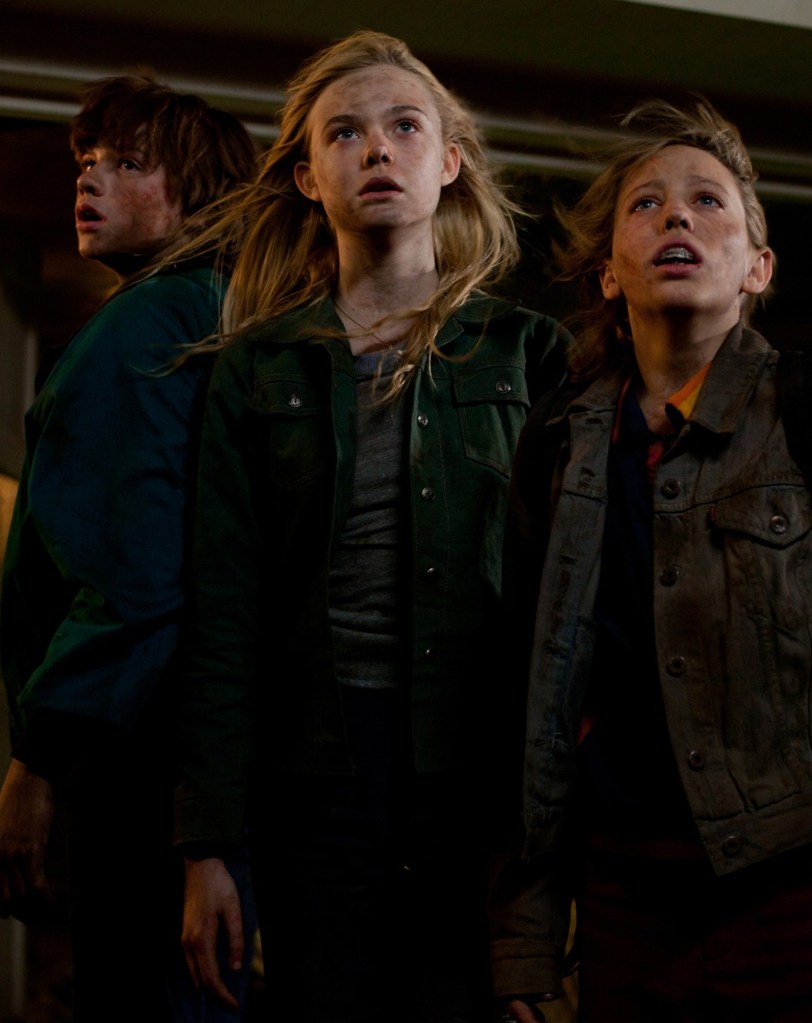 Yet Super 8, the third feature from director JJ Abrams, has always felt a little different. After catching our attention with last year’s mysterious trainwreck teaser clip, the filmmaker has tantalised us with the promise of a true genre piece that aims to capture the very best elements of 1980s adventure cinema, while injecting a healthy dose of modern edge and savvier sensibilities. Abrams’ intent is to create a genuine peer to the likes of ET: The Extra-Terrestrial or The Goonies, tapping into the themes and values that defined that era’s outlook, rather than simply relying on its brands and cultural touchstones as a nostalgic crutch. Seeing the finished film, it’s fair to say that he hasn’t entirely succeeded in meeting his ambitious goals, but the effort is accomplished and never anything less than interesting.
Inevitably, it’s difficult to even begin discussing any element of Super 8 without first addressing one particular bearded, Oscar-winning elephant in the room. In tackling this particular genre and era, Abrams was always going to be operating in the shadow of Steven Spielberg, the undisputed master of this domain; by handing the father of Amblin Entertainment a producer role, the director shows that he’s perfectly willing to lie back and enjoy the shade. Abrams wanted to make a genuine Amblin adventure film, and he’s chosen to do so by following Spielberg’s route map right down to the millimetre; so complete and overt is his adoption of the Bearded One’s style, themes and storytelling language (the ET-mimicking storyline, small-town vibe, themes of parental loss and coming of age, etc) that pointing it out feels akin to stating that the sky is blue.
 It would have been easy for a film following a preset template this closely to come across as lifeless, but Super 8 feels like the work of a director who understands the nuts and bolts of the theory he’s putting into practice, rather than simply following it by rote. Any old hack can cobble together some period costumes and hash out the basics of a kids-discover-aliens plot, but it takes more skill to create an atmosphere that nostalgically venerates the wistful feel of the turn of the Eighties – an ambiguous era characterised by its own nostalgia for the decades preceding it – while also infusing that sense of doe-eyed, dreamy, naive wonder that Spielberg seems to have copyrighted. More impressively, Abrams has also been able to add his own flavour to the familiar blend, most prominently in terms of the film’s central mystery element, which allows the Lost creator to bring his affinity for tension-building, creeping menace and misdirection to the fore.
The fruits of the Abrams/Spielberg alliance brought to bear most prominently in the young principle cast, a delightful collection of misfits that combine amusing snarkiness, youthful haplessness, precocious wisdom and tangible innocence in a massively watchable blend. Adult cast members such as Kyle Chandler and Ron Eldard turn in decent supporting performances, but can’t compete with the scene-stealing likes of Riley Griffiths’ bumptious amateur director Charles or Ryan Lee’s pint-sized pyromaniac Cary. However, it’s the sensitive central pairing of Joel Courtney’s Joe and Elle Fanning’s Alice that prove themselves to be Super 8’s key assets, their budding relationship and shared parental issues giving the film its heart and grounding, even in the face of massive setpieces such as the spectacular pivotal train crash.
 The merits of Super 8 are a testament to Abrams’ development as a feature director, offering a more substantial and solidly-founded experience than either Mission: Impossible III or the 2009 Star Trek. Yet conceptualisation and vision is nothing without conclusion, and sadly it’s in this area that Abrams shows he still has some growing left to do. For two-thirds of its running time, Super 8 is a self-confident, disciplined genre piece, but as soon as the film transitions into its third act, something within its internal structure seems to snap. The well-etched characters begin to make decisions based on narrative necessity, rather than convincing motivation; magic and discovery begin to be replaced by loud pyrotechnics; most fatally, the clouds of obfuscation surrounding the core mystery dissipate, revealing something far more conventional and infinitely less interesting than the build-up suggested.
 It’s at this point that detractors let down by the payoffs of Abrams projects such as Lost and Cloverfield will get their shots in, but even a sympathetic observer would find it hard to argue that Super 8’s destination lives up to its journey. It’s not just that the creature lurking at the heart of the film’s web of intrigue is a confused creation, staggering back and forth over the line between sympathetic and threatening; it’s the fact that this underwhelming narrative deadweight displaces so many superior elements, most vexingly including the story of Joe and Alice, whose separation in the final act removes much of the interpersonal interest that fuelled the rest of the film. Abrams is able to pull things back on course at the very end with an unsubtle but effectively Close Encounters-ish finale and a fabulous credits sequence (in which we get to see a completed version of the kids’ zombie film), but the prevailing feeling is that the director stumbles over the finish line, after running most of the race at an easy canter.
The inability to stick the landing registers as a great shame for Super 8, if only because what precedes it is good enough to suggest that Abrams and co did possess the talent to see this idea through to a more fitting conclusion. But it shouldn’t overshadow the accomplishments of a film that shows guts by intentionally placing itself in direct, unavoidable comparison with classics of its chosen genre and, for the majority of its duration, withstanding those comparisons with a decent amount of flair. For all its flaws, Super 8 stands as one of the most artistically interesting products of the current 1980s revival trend, and suggests that JJ Abrams could have a genuinely great film in him somewhere down the line. As long as he keeps taking lessons from the very best, he may well get there.
The Verdict: The most authentic 1980s Spielberg movie ever to not be directed by Steven Spielberg, Super 8 falters in the final stretch, but its praiseworthy ambition, winning cast and exemplary craftsmanship ultimately make JJ Abrams’ best film so far a difficult one to begrudge.
[amtap amazon:asin=B0052EV846]
[amtap amazon:asin=B003L76RYW]


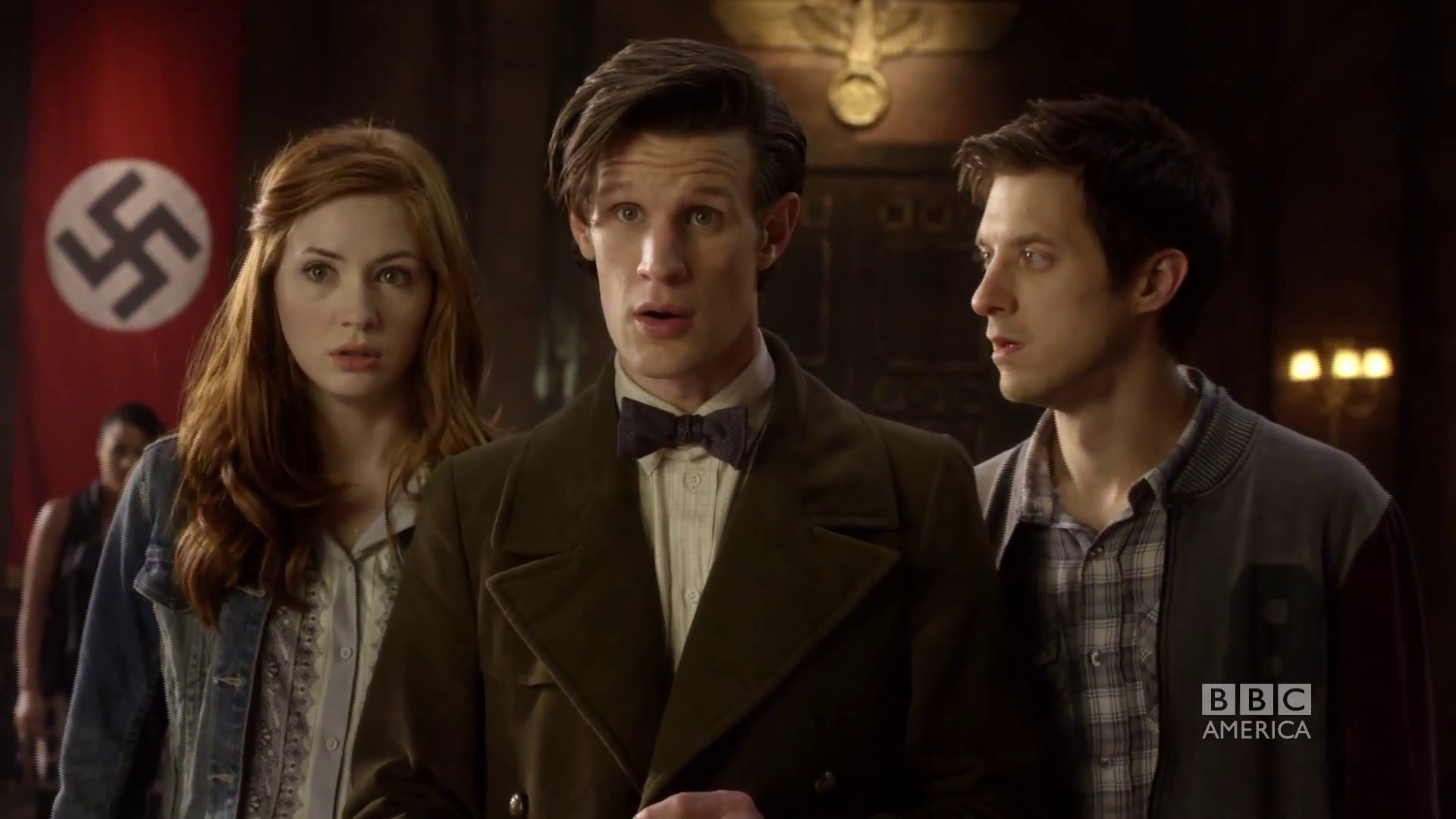


-
Subscribe
Subscribed
Have a WordPress.com account? Log in now.

