Movie Review: True Grit

Cast: Jeff Bridges, Hailee Steinfeld, Matt Damon, Josh Brolin, Barry Pepper ~ Writers/Directors: Joel and Ethan Coen ~ Rating: 15 ~ Year: 2010

True Grit Movie Poster Coen Brothers 2010[xrr rating=4/5]

The Lowdown: The Western rides again thanks to the Coen Brothers, who’ve taken a novel originally filmed in 1969 with John Wayne and turned it into a powerful and moody portrait of the Old West, backed up by fantastic performances from Jeff Bridges and newcomer Hailee Steinfeld.

What’s it About?: 14-year old farm girl Mattie Ross (Steinfeld) has only one thing she wants – to see runaway criminal Tom Chaney (Brolin) hang for the murder of her father. However, Chaney has vanished deep inside the Indian Nations, and the only person she can find to help her is US Marshall Reuben ‘Rooster’ Cogburn (Bridges), a one-eyed shambling disaster of a man who seems more interested in whiskey than justice…

The Story: The rule is simple – never remake a classic. There’s so many elements that can go wrong second time around, so it’s often much easier to take on a film that isn’t quite so revered, as in the case of True Grit. Filmed in 1969, the John Wayne-starring version is actually a fairly good example of a mainstream Hollywood Western in the late Sixties, but it’s really best remembered for Wayne’s showboating performance, playing off his iconic status as the cantankerous, whiskey-soaked Cogburn (and netting him his only Oscar), and doesn’t always do justice to Charles Portis’s original novel. As a result, there weren’t any cries of horror when the Coen Brothers announced their intention to do a new interpretation of True Grit, and what we’ve ended up with is a very different version of the same story, taking the original novel and creating something much darker, more ruminative and violent.

True Grit 2010 Jeff Bridges Hailee SteinfeldBecause make no mistake – while there’s plenty of humour on display here, this is a story of justice, and the kind of price you pay for both seeking and defying it. Mattie Ross’ determined quest to avenge her father is brave and compelling, but it’s never framed as anything other than an extremely dangerous journey into dark territory that’s populated by dangerous men. There’s very little escapism or romance in the Coen’s portrait of the West – Mattie spends the film surrounded by death (even having to sleep at an undertakers in an early scene), and her quest eventually results in a serious price to pay, while the West itself is a spectacular but frightening place, a bleak and barren country where there’s little comfort (but plenty of room for occasional bursts of very Coen-Brother weirdness, like the bizarre encounter with a roaming wilderness Dentist).

True Grit 2010 Jeff BridgesWhen the action comes, it’s brilliantly handled and sometimes shocking, but the Coens mainly keep the pace gentle, focussing on the characters and showcasing their usual talent at bringing out strong performances. It’s no surprise that Bridges is excellent – he’s one of the most reliable character actors in Hollywood – but he does an amazing job as Cogburn, buried behind an eyepatch and a sometimes-incomprehensible accent, creating a character who’s both entertaining and dangerous, riding a risky moral line and being admirable without ever seeming entirely reliable or trustworthy.

True Grit 2010 Jeff Bridges Hailee Steinfeld stillThere’s also excellent work from Matt Damon, giving Texas Ranger LaBoeuf plenty of depth and pomposity, while Josh Brolin does plenty with only a handful of scenes as Cheney, but the whole film is stolen wholesale by Hailee Steinfeld who’s simply incredible as Mattie Ross, appearing in almost every scene and matching her co-stars line for line. The early sequence where she manages to talk around a tradesman who’s unwilling to buy back a number of horses is worth the price of admission alone, and Steinfeld holds the whole film together with a realism and charisma that you don’t often see in teen actresses.

True Grit sits at the more commercial end of the Coen Brothers’ work, although it’s definitely a successful fusion of art and commerce (especially now that it’s made over $100 million in the States). While it isn’t quite as distinctive or peculiarly moving as the fantastically quirky A Serious Man, or as gut-punchingly powerful as No Country for Old Men, it’s still a fascinating and rewarding piece of cinema, backed up with a typically excellent and moving score from Carter Burwell. In a way, it also makes a kind of odd double-bill with Clint Eastwood’s Unforgiven – and while it isn’t quite as determined to demythologise the West, it certainly takes the shine off the legend, showing it as a pretty merciless place that only cantankerous, morally dubious men like Bridges’ Cogburn are truly built to survive.

The Verdict: Darker and more melancholic than you might expect, True Grit contains plenty of the classic hallmarks of the Western, but it’s most memorable for the Coen Brothers’ more characterful touches, and the fantastic performances of both Bridges and Steinfeld.

[amtap book:isbn=0747572631]

[amtap amazon:asin=B004BDOEYK]

Movie News: Shane Black to direct Iron Man 3?

Iron Man 3 News

I have to admit – I’m slightly perplexed by exactly how much love the movie version of Iron Man got. Make no mistake, it’s a fun and frothy blockbuster, but I was surprised by exactly how bowled over people were, when Jon Favreau has never struck me as the most dynamic or exciting director (although I am currently keen to see how his upcoming movie Cowboys and Aliens turns out), and the original Iron Man was very much one of those superhero blockbusters that’s an effective origin story with an extra act of clunky action awkwardly welded on to the end.

I wasn’t entirely surprised when Iron Man 2 turned out to be a damp squib more concerned with trailing the upcoming 2012 Avengers project than actually telling a good story, giving us a rather lazy version of ‘more of the same’ instead of trying to deliver something new. However, there have been various behind-the-scenes rumblings that the Iron Man films have not exactly been smooth productions, with Marvel being rather hands-on and also being in the habit of starting to shoot without a fixed script. As a result, Jon Favreau has headed off to pastures new, and Marvel are looking at new directors to step into the chair for the obviously-going-to-happen Iron Man 3.

Shane Black Possible Iron Man 3 DirectorAmazingly, according to Deadline, we’re actually getting very close to Shane Black signing to direct the third Iron Man film. Black was one of the biggest screenwriters in Hollywood in the late Eighties, netting massive amounts of money for scripts like Lethal Weapon (and also achieving the rather bizarre notoriety of being the first soldier to be killed by the titular alien in John McTiernan’s macho classic Predator). His whip-smart style fell out of favour in the late Nineties, but he’s been making a slow but steady comeback for the last few years. His directorial debut Kiss Kiss Bang Bang is a flawed but wonderful noir comedy that features some dazzlingly brilliant dialogue, a hilarious turn from Val Kilmer as a gay private eye, and also – in a nice piece of synchronicity – gave Robert Downey Jr one of his best roles prior to embarking on major stardom in iron Man.

Iron Man 3 News Update Robert Downey JrThe fact that Black may be getting a gig this major is excellent news – the only thing that’s concerning is that, according to the Deadline article, there’s a question mark over whether or not Black is going to write the script. It’s interesting that Marvel are going for someone like Black, but he strikes me as the kind of writer who’s best when he’s let off the leash – it’d be extremely weird to hire him, and then impose the kind of creative control that throttled the life out of Iron Man 2. Marvel are still riding on the success of Iron Man, and the anticipation for The Avengers, but that isn’t going to last forever, and both Thor and Captain America: The First Avenger are going to have to be extremely good if the plan’s going to work. I hope Black gets the chance to make Iron Man 3 – but I also hope that Marvel are sensible enough to let him subvert and change the formula, rather than forcing him to make yet another tale of Tony Stark being a bit of an arse, realising the error of his ways, and then fighting another bloke in a big metal suit…

Video: ‘Tis THOR That Commands! (A New ‘Thor’ Trailer)

You can almost sense Marvel Studio’s slight sense of nervousness about Thor. After all, while audiences flocked to Iron Man (and even to the less-than-ideal Iron Man 2), it’s a bit of a leap from Robert Downey Jr being a charmingly flawed hero in a mechanical suit to Norse Gods hurling hammers at each other and intoning cod-Shakespearean dialogue. At the least, they’ve enlisted Kenneth Brannagh as the director – a man who knows Shakespearean dialogue when he hears it – and the initial trailers have looked potentially fun, if not necessarily the guaranteed slam-dunk Marvel needs if the whole shared-universe build up to The Avengers in 2012 is actually going to work. Nevertheless, we’ve got a new trailer, this one giving more of the Natalie Portman end of the Thor story, and it certainly looks like this is going to be riding the line between entertaining and absurdly cheesy. I remain yet to be completely convinced by Chris Hemsworth – but it certainly looks lively, and still has me a lot more excited than other upcoming superhero films I could mention (Yes, I’m looking at you, Green Lantern)…

Video: Zombie Surprise (The jaw-dropping ‘Dead Island’ computer game trailer)

A computer game featuring Zombies is hardly news, nor is the fact that it’s obviously going to be insanely violent. The trailer for the upcoming Zombie game Dead Island, however, is something different. Computer game trailers like this have been getting more impressive over the last few years (Hell, the recent ones for upcoming MMORPG Star Wars: The Old Republic have arguably been the best and most exciting Star Wars material since the original trilogy), and the Dead Island trailer is a seriously impressive three minutes of storytelling that delivers a hell of a lot more emotional impact than you’d expect from this kind of thing. It is, of course, extremely violent, very gory and decidedly NSFW, so if you have any problems with full-on Zombie violence don’t watch it – but if that kind of thing is your bag, prepare to be surprised and impressed…

Comic Review – Morning Glories : Volume One

Writer: Nick Spencer ~ Artist: Joe Eisma ~ Colours: Alex Sollazzo ~ Publisher: Image Comics ~ Year: 2010

[xrr rating=4/5]

Morning Glories Volume 1 For A Better Future coverThe Low-Down: A sharp and witty cross between Buffy the Vampire Slayer and The Prisoner (with a running mystery that equals Lost for sheer pulp unfathomability), this high school saga is overcoming a few art-related issues and shaping up to be a compulsively entertaining read.

What’s it About?: Six accomplished teenage students are offered the chance of a lifetime – a scholarship at the prestigious Morning Glory Academy. It’s an institution that’s searching for excellence, but its location is a secret, escape is impossible, and its methods include torture, mind-games and murder. Secrets are waiting to be discovered in the depths of the Academy, as the six newcomers find themselves locked in a lethal game of cat-and-mouse with their teachers. But what does the phrase “The hour of our release draws near” have to do with all this?

The Story: It’s always easy to be suspicious of hype, especially in the world of comics. When a title becomes a sell-out smash hit, it often has more to do with marketing and how ‘important’ or how much of an ‘event’ the relevant comic is than whether or not it’s any good. So, when new series Morning Glories sold out two separate printings of its first issue, it’d be easy to be cynical –if it wasn’t for the fact that it’s also a well-crafted, entertaining and intriguing story that’s heading in some extremely promising directions.

Morning Glories Page Art Joe EismaWe’re unashamedly in Teen Drama territory here, with a group of disparate characters being brought together to face an as-yet-unspecified threat (and also overcome various issues in their past). While there are plenty of echoes of early Buffy the Vampire Slayer episodes here (especially with the ‘High School that hides dark secrets’ setup) what’s more interesting is the way that up-and-coming writer Nick Spencer has structured this as a battle of wills between our teenage heroes and the teachers who are trying to manipulate, interrogate and control them. In short, it’s Buffy meets Sixties cult classic TV series The Prisoner, with an accompanying dose of the characterisation, structure and mad pulp stylings of Lost.

The overarching mystery is certainly going in directions that could be described as ‘unexpected’ (especially when it becomes clear that fifteenth century Spain is somehow connected), and Spencer delivers a number of effective shocks that build up the sense of intrigue, while also pulling off some very nicely played and engaging character moments. In the first chapter, there’s one of the best examples of the ‘meet-cute’ scene, between lead characters Casey and Hunter, that I’ve seen in a long time, and Spencer keeps the pace up while giving the characters depth and believability. He also isn’t afraid to throw violence into the equation – the stakes are high, and certain sequences feature major levels of blood, but the story binds all the mysteries together, pacing the whole saga as a compulsive teen thriller.

Morning Glories Art Joe EismaThere’s a long game at work here – seeds are being laid for a long-running mystery, especially in the sixth chapter collected here, which plays as a Lost-style ‘inbetweener’ episode that shows us a very different perspective on events and throws in some major surprises. Aside from a couple of creaky lines, Spencer’s dialogue is top-notch, the characters are engaging, and the mystery is absorbing. In short, it’s the kind of comic project that has “Soon to be optioned as a Movie or TV Series” written all over it, and given its already impressive success, Morning Glories looks likely to continue being an intriguing and engaging comic book read.

Morning Glories Page Art Joe Eisma 2The Art: Unfortunately, if there’s one area where Morning Glories hasn’t completely won me over, it’s the art. Joe Eisma’s work is sometimes very impressive, but his very line-heavy, sometimes angular approach to character’s faces means that certain panels work better than others, and doesn’t always seem to blend well with Alex Sollazo’s colour work. At times, Eisma’s able to make the dialogue scenes incredibly expressive, but he also has occasional difficulties making his female characters look different from each other, while his habit of drawing people with slightly toothy grins and staring eyes gets a little off-putting at times. It’s a shame, because he’s also extremely good at creating atmosphere, pulling off some effective compositions and grisly moments of violence (especially the sequences featuring the mysterious ‘cylinder’ in the basement of the school). It’s one of those frustrating comics where the cover art (from Rodin Esquejo) is sometimes more eyecatching than the interior work, but it’s very likely that Eisma’s style and approach will evolve as the story goes on, so hopefully these are just initial teething troubles that’ll sort themselves out soon.

The Verdict: There are a few moments where the series is still finding its feet, but the central mysteries of Morning Glories will pull you in, and the strong characterisation makes this a ride that’s well worth taking.

[amtap book:isbn=1607063611]

Video/Audio: Movie Tech-A-Go-Go (Sound and Vision – TRON: Legacy, The Social Network and Inception)

It’s time to indulge my love of finding out the fine details of how certain movies are made, and here’s a couple of videos I tracked down that give in-depth looks at aspects of two of the more attention-grabbing films of the last few months (admittedly, they’re attention grabbing for very different reasons). First up, here’s a one hour in-depth panel discussion with the sound and editing team from TRON: Legacy, giving a detailed look at the development and creation of the movie’s soundscapes from the initial teaser right through to the finished film:

“TRON LEGACY” – Sound Panel from Michael Coleman on Vimeo.

And secondly, here’s another panel discussion, but this one dealing with music and sound design on a very different kind of movie – David Fincher’s brilliant portrait of the birth of Facebook, The Social Network. In this 45-minute discussion, there’s lots of attention paid both to the sound design and the music itself, and composers Trent Reznor and Atticus Ross have a lot to say about the thoughts that went into creating a brilliant piece of electronica and one of 2010’s finest film soundtracks:

The Sound and Music of “The Social Network” Panel from Michael Coleman on Vimeo.

Finally, here, via BDKreviews.com, is a 45 minute audio interview with Wally Pfister, the cinematographer who’s worked on every single Christopher Nolan film since Memento, and here gives plenty of info on Nolan’s working methods and the technical know-how behind the mind-bending SF thriller Inception, as well as giving out some vague but extremely interesting tidbits concerning Nolan’s upcoming third Batman movie The Dark Knight Rises…

[amtap amazon:asin=B003DNSQZW]

[amtap amazon:asin=B003NE4S9O]

[amtap amazon:asin=B0043ISH6O]

[amtap amazon:asin=B003H04O7U]

Video: Star Wars Begins

You can’t throw a brick on the internet without hitting a Star Wars-related image/cartoon/video somewhere. One of the most heavily watched in recent years is, of course, the Red Letter Media series of epic video reviews of the Prequels, most notably the one dealing with The Phantom Menace (which would be a dazzling piece of film criticism, if it wasn’t for the tiresome and rather mean-spirited ‘Serial Killer reviews a movie’ gag that’s been eventually run into the ground), and much of what’s out there deals heavily with the truly gigantic level of disillusionment Star Wars fandom went through as a result of the prequels. Certainly, it’d take something astonishing to actually get me truly excited about any Star Wars-related project now (the fact that we’ve now got 3-D conversions of all the films coming up had me basically thinking “So What?”) and I know there are plenty who feel the same.

However – there are people out there who’ve kept the faith, and one of them (Youtube user jambedavdar) has made a fan documentary that, frankly, will take some beating. Star Wars Begins is a fourteen part, two-and-a-half-hour documentary that takes you through the whole movie and shows you alternate takes, storyboards, deleted scenes, behind-the-scenes footage and concept work, as well as giving you a gigantic selection of audio interviews with a massive number of both the cast and crew. There’s a lot of minute detail here (including things like minor differences in dialogue between versions), but there’s also some big surprises, and a gigantic amount of trivia in what adds up to the greatest unofficial Star Wars DVD extra ever. A long watch but one that’s well worth it, Star Wars Begins is a fascinating exploration of the magic of old-school movie making, as well as a reminder that before the franchise, before the prequels, and before the disappointment, Star Wars was just a movie – and a rather bloody good one, too…

Continue reading

Novel Review: The Dancers at the End of Time

Author: Michael Moorcock ~ Pages: 672pp ~ Publisher: Gollancz ~ Year: 1981

The Dancers at the end of Time Michael Moorcock

[xrr rating=5/5]

The Low-Down: A magical, whimsical and beautifully written trilogy of eccentric science fiction from one of fantasy literature’s biggest names, this is also a time-travel romance that’s witty, well-crafted and ultimately moving.

What’s it About?: Far in the future, near the end of the universe, the remains of humanity lives an immortal, decadent and morality-free existance where anything is possible. But when Jherek Carnelian falls for accidental Victorian time-traveller Mrs Amelia Underwood, the resulting love affair takes them all across time, and into many kinds of bizarre dangers…

The Book: Warm, witty and hopelessly romantic, The Dancers at the End of Time is the omnibus edition of a trilogy of novels (An Alien Heat, The Hollow Lands and The End of All Songs) written in the mid 1970s by massively prolific fantasy author and genre titan Michael Moorcock –  and it stands on the border between his more traditional sword-and-sorcery fantasy (the Elric, Hawkmoon and Corum novels), and his more challenging and literate work (The Cornelius and Pyat novels, as well as works like Mother London). Moorcock is one of those authors who can be intimidating simply due to how much he’s produced, but The Dancers of the End of Time is a very accessible starting point, especially since despite being a mixture of science fiction, romance and comedy, it’s mainly influenced by early twentieth century literature, especially the works of Oscar Wilde.

What Moorcock has produced here is a beautifully charming and ceaselessly imaginative romantic comedy, and the level of invention in the trilogy is amazing, conjuring up a colourful and surreal world at the End of Time and packing it with a lively selection of memorable and distinctive characters. It’s also thematically daring right from the start – this is a book where, thanks to the decadent ‘anything goes’ nature of the End of Time, the main character has sex with his own mother within the first three pages of the book, and while Moorcock has tremendous fun colliding his playful, morality-free world with the staunch and moralistic Victorian outlook, it isn’t just culture-clash comedy for its own sake. Instead, the love affair that blossoms between Jherek Carnelian and Mrs Amelia Underwood really does examine the nature of morality, and the craft and skill with which Moorcock explores this central idea is truly exceptional.

Mixing comedy with social satire and genuine romance, it’s a unique read that manages to be engaging throughout all three of its volumes, and it’s almost impossible not to be swept along by the trials and tribulations of the central relationship. It’s true that the longer and more melancholic concluding volume The End of All Songs doesn’t quite have the level of frothy comedy that Moorcock pulls off in An Alien Heat and The Hollow Lands, but it does tackle some daring science fictional territory, while still keeping the focus firmly on the characters, and the evolving relationship between the two protagonists. Back in the early twentieth century, books like The Time Machine would be described as ‘Scientific Romances’, and that’s exactly what The Dancers at the End of Time is – a magical and moving Scientific Romance that’s an incredibly distinctive work of literature, and the kind of off-beat yet moving saga that’s very easy to get lost in.

The Verdict: A tale of love, heartbreak and morality that stretches across the entire history of the universe, The Dancers at the End of Time is a quirky and utterly English tale of romance and entropy that simply demands to be read.

[amtap book:isbn=0575074760]

TV News: How Do You Solve a Problem like Wonder Woman? (Pilot Episode Details…)

Wonder Woman Terry Dodson

Wonder Woman Lynda CarterAh, Wonder Woman – the Amazon princess of Themyscira who’s sent to Man’s world as an emissary of Peace, a job that seems to involve a remarkable amount of beating people up, battling evil and repelling bullets with her magical arm gauntlets. She’s massively recognisable. She’s one of the most long-running superheroes around. She’s a female icon, a wish-fulfilment figure and a role model… and yet she hasn’t managed a non-animated onscreen appearance since the fabulously campy Seventies TV series starring Lynda Carter. It’s not for want of trying – there’s been a whole series of attempts to bring Wonder Woman back to the screen (most notably in 2005, when Buffy creator Joss Whedon was hired to do a reboot) but all of them have either failed or stalled.

Now, however, Wonder Woman may be on her way back to TV screens, thanks to a rather unlikely benefactor. If you were going to make a list of potential producers for a TV version of Wonder Woman, it’s very unlikely that David E. Kelly – the king of kooky courtroom drama and creator of shows like Ally McBeal and Boston Legal – would have made the cut. However, proving that you can never predict exactly how weird Hollywood can get, a Wonder Woman TV project is looking very likely, a pilot episode is being put together at US network NBC, and David E. Kelly is the man in charge. Details of the pilot script have filtered out via film/tv/comics site Bleeding Cool, and it’s certainly sounding a very David E. Kelly show – by the sounds of it, it’ll be a frothy relationship-driven superhero comedy drama with a fair selection of continuity from the original comics, but aiming more at the mainstream network audience, and certainly in no way trying to do the straight, mythic and serious take that plenty of fans seem to want.

(A quick summary of most of the details we’ve got – essentially, the setup is that Wonder Woman is Diana Themyscira, head of the Themyscira Corporation, and publicly moonlights as a superhero (think Tony Stark and Iron Man), but also uses the mild-mannered alter ego of Diana Prince from time to time. The general mood seems to be goofy female-oriented superhero drama, with a slightly worrying number of pop songs listed in the script (there’s apparently going to be a fight scene scored by ‘Single Ladies’ by Beyonce, which doesn’t exactly fill me with hope), and from most of what I’ve read in the Bleeding Cool article, it does feel like the closest reference point is going to be that fabulously Nineties TV take on Superman, Lois and Clark (also known over here as The New Adventures of Superman) – or, at least, the earlier episodes of Lois and Clark where the relationship-driven comedy worked, and the whole concept hadn’t been run into the ground yet).

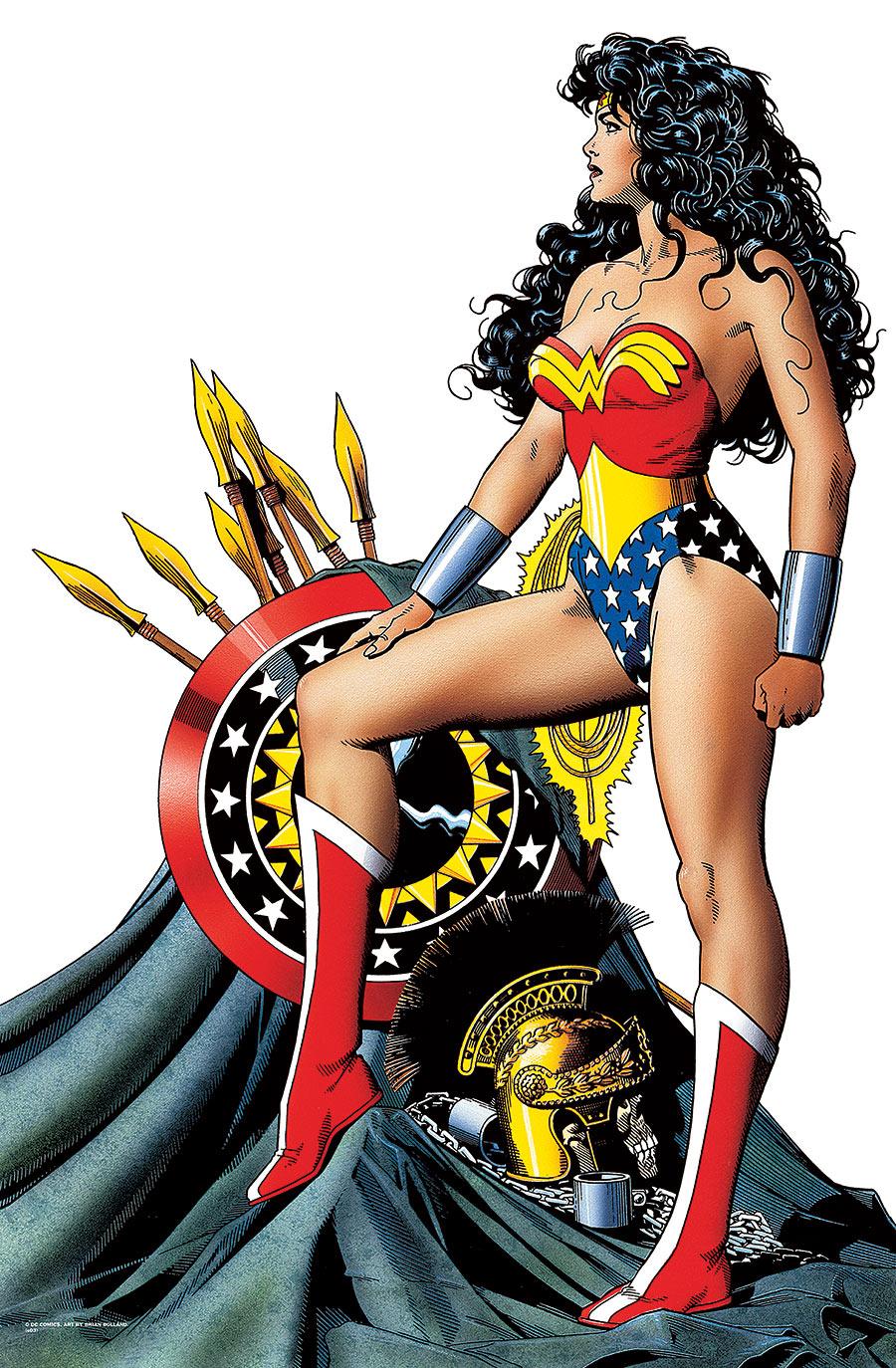
Wonder Woman Brian BollandAt this stage, I’m neither loving nor hating what I’m hearing. A lot will depend on execution, and Wonder Woman isn’t a character I’m especially invested in – it does read like the kind of thing that’s more likely to fail than succeed, but pilot episodes can be notoriously clunky anyway, and I’m willing to at least give it a little benefit of the doubt (until I’ve actually seen the episode in question) as this could go either way. Kelly’s take might be a smash success or a blink-and-you’ll-miss-it failure (like the TV adaptation of female-centric Batman universe comic Birds of Prey, which was cancelled so quickly, hardly anyone even noticed that it existed), but it’s interesting in that it shows exactly how much uncertainty there is over how to do Wonder Woman onscreen, a lot more than there ever was with a character like Batman and Superman.

A little of it is simply to do with the fact that superhero tales tend to be pretty big budget (especially if we’re talking movies), and female-driven superhero movies don’t exactly have a fantastic strike rate of success (evidence for the prosecution: Supergirl, Elektra, and the stunningly awful Catwoman). Much of this is down to bad luck and rotten creative decisions, but there’s also the problem that big budget superhero films need to be pitched as wide as possible, and I don’t think anyone has yet to crack how to sell the kind of major-league, female-oriented superhero blockbuster that they’d need if they were going to give Wonder Woman the cinematic outing her following and history deserves.

Wonder WomanOn top of that, Wonder Woman is a tricky character whose origin story has been tweaked, rebooted and remixed a surprising number of times over the years. For example, while there have been wildly different interpretations of Batman, it’s hard to imagine anyone ever suggesting “Hey, you know what? What if Bruce Wayne gave up all the dressing up as a bat, and instead we had him travelling the world as a daring spy who poses as an international playboy? Maybe his codename could still be ‘The Bat’!” And yet, that’s exactly what happened to Wonder Woman for several years, from the late sixties to the mid seventies, when she was de-powered and transformed into a fab and groovy secret agent. There have been other massive changes over the years, and Wonder Woman’s origin isn’t the kind of clear-cut tale that you can sum up as easily and succinctly as Grant Morrison and Frank Quitely managed in the first page of their magnum opus, All-Star Superman:

all-star_superman_origin

Even now, DC are struggling with the character – she’s in the middle of an ‘alternate history’ revamp, a ‘bold new direction’ that was thought up by writer J. Michael Straczynski before he jumped ship from writing monthly comics, and which seems to have turned her into a cross between Xena: Warrior Princess and the DC Comics beserker warrior equivalent of Wolverine. It’s not as much of a car-crash as Straczynski’s god-awful “Superman walks across America” tale Grounded, but after about six issues, it really doesn’t feel like it’s working (even with a mild upswing in quality thanks to Chris Roberson taking over scripting duties). They’ve also, as part of the remix, given her a much-heralded new costume:

wonder woman new costume jim lee

I’m going to go out on a limb here and say that I don’t actually have a problem with this, and as superhero costumes go, it’s pretty good. The jacket is still ridiculously Nineties, but the ensemble works, and it doesn’t say “armoured swimming costume” in the same way that the classic WW costume does. Yes, it does take away a certain degree of Wonder Woman’s mythic nature but it also, frankly, is a more practical costume that would very probably be much easier to realise onscreen without drifting into the kind of campness that Xena or, to be honest, the Seventies TV show survived on.

wonder woman alex rossAnother problem with Wonder Woman is her mythic nature. She was created in the Nineteen Forties as a female adventurer to battle the Nazis, a long time before the Sixties Marvel revolution made street-level, ordinary-joe superheroes the done thing. As a result, she’s a character of pure myth (plenty of versions of the origin have her actually sculpted from clay by the Gods), and there’s a sense of distance from all the DC ‘Big Three’ – the feeling that they’re Olympian ideals to aspire to. That’s a tricky thing to pull off, especially in the post-Eighties/Nineties era when superhero comics are at least attempting a bit more psychological depth (even if they don’t always manage it), and I really don’t feel like anyone’s ever entirely cracked how to handle this.

There’s also the lack of a single definitive Wonder Woman story. As I’ve said, I haven’t read a heap of Wonder Woman comics, so I’m coming at this as an outsider, but especially in the last twenty five years, in the post Dark Knight and Watchmen comics landscape, there hasn’t been a comic that has truly defined Wonder Woman as a character in the same way that, say, The Dark Knight Returns or The Killing Joke have for Batman. I’m sure there have been some great runs of stories and some impressive creators have worked on the title (including writers like Greg Rucka and Gail Simone), but it feels like what’s needed is someone to take Wonder Woman and do something attention-grabbing and truly different with her (which I suspect was what Straczynski was trying to do with his rather ill-fated concept, unfortunately).

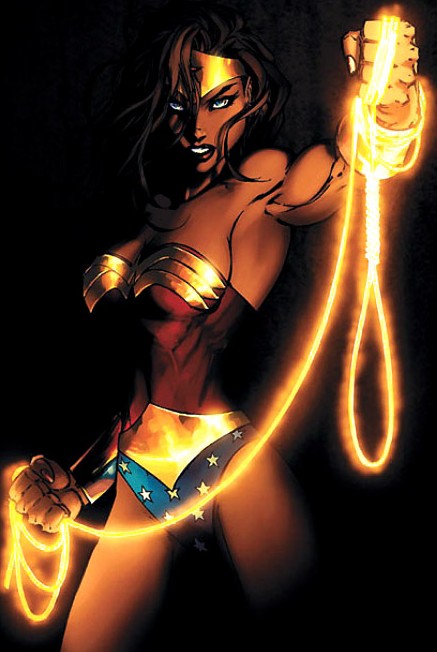
Wonder Woman Lasso of TruthOn top of all that, there’s the question of how close a screen version should stick to the comic, especially when there are aspects of the comic which (to put it mildly) might be tricky to transfer? The 2009 animated Wonder Woman direct-to-DVD film is a good example of this – it’s fine when it’s sticking to pure myth (featuring a 300-style flashback opening sequence), but comes unstuck when it has to do tackle some of the trickier aspects – and yes, we’re talking about the Lasso of Truth. Back in the Forties, there was a deliberate layer of kink to many Wonder Woman stories (with the mighty Amazon coming up against a wide variety of villains who seemed very fond of tying her up time after time), and the Lasso of Truth – the magical rope which, when tied around someone’s neck, compels them to tell the truth – is a direct descendant of this kind of storytelling.

It’s the kind of thing that’s much easier to play in a comic book than in reality, and that’s the main problem with Wonder Woman – you’ve got a character who’s a mass of challenging aspects, many of which could be breathtakingly silly if done wrong, and which doesn’t even have a clear, definitive set of stories which you can look to as an obvious blueprint for a screen adaptation. If anyone wants to set me straight and say “Well, of course there’s issues XXX to XXX”, then I’ll be extremely grateful, but considering these inherent problems, I’m really not surprised that nobody’s been able to get a full-on live action version of Wonder Woman out of development. In pop culture terms, she’s kind of where Batman was before the Tim Burton-directed 1989 blockbuster – the Seventies Lynda Carter show is still, despite its nuclear levels of camp, the main touchstone for what people (at least of a certain age) think when they think ‘Wonder Woman’. What she really needs is someone like Burton to come along and do something incredibly distinctive with her – knock the origin into a coherent shape, choose what they want and leave the rest on the comic page, and craft something which will be distinctive and attention-grabbing.

Now, for the record – I don’t think from what I’ve heard that Kelly’s TV adaptation is going to be that. It’s definitely going to earn a lot of fan hatred even before a second of it has been broadcast, and I don’t know that if my favourite comic book character was going to be changed that radically, I’d be particularly happy. But, I suspect that if Wonder Woman is ever going to succeed onscreen, she’s going to have to be changed – she’s going to have to be a specific interpretation. Until then, she’s going to remain an icon that everybody knows, but which remains frustratingly difficult to adapt…

Comic Review – Batman : The Return of Bruce Wayne (Deluxe Edition)

Writer: Grant Morrison ~ Artists: Chris Sprouse, Frazer Irving, Yannette Paquette, Georges Jeanty, Ryan Sook, Lee Garbett ~ Publisher: DC Comics ~ Year: 2011

Return of Bruce Wayne Deluxe - cover[xrr rating=3.5/5]

The Low-Down: The return through time of the original Batman is as mindbending as you’d expect from the pen of controversial comics creator Grant Morrison. A wild, colourful and inventive journey through pulp storytelling, The Return of Bruce Wayne has some serious consistency problems and is in no way a ‘jumping on’ point, but the combination of adventure, mythmaking and experimental storytelling makes for a heady and entertaining brew.

The Backstory: He witnessed his parents’ murder when only eleven years old. Up until recently, multi-millionaire Bruce Wayne secretly used his resources, training and cunning to fight crime on the streets of Gotham under the costumed identity of the Batman – but after an apocalyptic confrontation with the god-like Darkseid, Wayne was apparently killed, and ex-sidekick Dick Grayson took over the mantle of the Caped Crusader.

What’s it About?: Bruce Wayne is far from dead. Displaced in time by the ‘Omega Effect’, he’s now lost in history, his memory in tatters, facing untold dangers in timezone after timezone, fighting to find his way back to the present day. Along the way, he’s also discovering dark secrets of the Wayne family, as well as clues to the identity of Dr. Hurt, the arch-criminal behind the organisation known as the Black Glove. Nothing is going to stop him from reaching his destination – but Darkseid already planned for this, and if Bruce Wayme arrives in the twenty-first century, it could mean destruction for everyone…

Return of Bruce Wayne #1 - Page 30The Story: There are some superhero stories where you can easily leap into the fray… and there are some where it’s a really bad idea. Grant Morrison’s comics have always been demanding and heavily interlinked, but his epic run on Batman has taken things to another level. Since 2006, he’s been telling a sprawling, ambitious novel-like story (which has also stretched into series like Final Crisis and Seven Soldiers of Victory), and just to make matters even more complicated, much of The Return of Bruce Wayne fits closely together with stories in his acclaimed run on Batman and Robin (especially ‘Batman vs Robin’ and ‘Batman and Robin Must Die!’ in volumes 2 and 3). So, if you’re looking for traditional, easily accessible superhero action – move along, there nothing for you here.

That’s not to say that The Return of Bruce Wayne doesn’t have plenty to offer, just that like ‘Batman R.I.P’, this is a smaller portion of a much larger work. Throughout his run on Batman, Morrison has been deliberately embracing the crazier elements of Batman’s lengthy history (most notably, working many of the overly camp 1950s-published sci-fi Batman stories into the fantastically twisted and disturbing ‘Batman R.I.P.’), and The Return of Bruce Wayne is the most extreme he’s gone yet. At first glimpse, there shouldn’t be anything further away from a traditional Batman tale than a crazy time-warp adventure that includes such memorable sights as Caveman Batman, Pilgrim Batman and Pirate Batman (although it has to be said, the story’s brief pirate persona for Bruce Wayne isn’t anywhere near as fun as Andy Kubert’s ludicrously brilliant cover illustration).

Batman Return of Bruce Wayne #3 - thebatrangerAnd yet, what Morrison has done is strip Batman down to barest essentials and rebuild him, while also putting Bruce Wayne in his proper context as a pulp hero. Each chapter of the story gives a new twist, exploring a different aspect of the character, pitching him against the ultimate enemy – History itself – and the end result is a deliriously barmy adventure that stretches a mystery across time, and raises the Batman to a truly mythic level.It also links back in surprising ways with ‘Batman: R.I.P’ and ‘Final Crisis’, layering in a massive amount of detail and pulling off some truly mind-expanding moments, especially in the Jack Kirby-esque science fictional final chapter.

It’s also true, though, that Morrison does throw a few too many ideas into the mix at times, and the book overall doesn’t always hit the fantastic highs of the brilliant Stone-Age-set opening chapter. There’s also the fact that we don’t really get the complete finale of Wayne’s time-travel adventures and Morrison’s uber-storyline here – the rest appears in the stories to be published in the upcoming Batman and Robin volume 3 – while DC’s decision not to reprint the key Batman issues 701 and 702 here (the atmospheric story ‘R.I.P.- The Missing Chapter’, which perfectly bridges the gap between ‘R.I.P’ and ‘Final Crisis’) means that it’s even harder to play catch-up than before. However, for those willing to try and keep up, what this collection lacks in consistency, it makes up for in adventurousness, creativity and sheer pulp pleasure.

Batman Return of Bruce Wayne Frazer IrvingThe Art: The plan was for each issue of this six-issue miniseries to be handled by a single artist, most of whom had worked with Morrison before (except for Chris Sprouse) – unfortunately, delays and production problems threw a spanner in the works, which means that the first half of The Return of Bruce Wayne is a very different visual proposition from the second. In the first three issues, we have Chris Sprouse’s clean and classical pulp stylings in the Caveman issue, the moody and lush digitally painted work of Frazer Irving on the Pilgrim issue, and the atmospheric pencils of Yannick Paquette on the Pirate story.

Sadly, Cameron Stewart dropped out of doing issue 4, the Western chapter, and while Georges Jeanty (best known for his work on the comic book ‘Season 8’ of Buffy the Vampire Slayer) pulls off some strong moments, his storytelling gets murky at times. The remaining two issues also see a major amount of work from fill-in artists, which is especially frustrating in the massively ambitious chapter 6. It often feels like Morrison is cursed to always see his most adventurous scripts plagued with production issues (similar problems affected the final volume of his Vertigo series The Invisibles), and The Return of Bruce Wayne is left halfway between being a major artistic showcase and a slightly rushed patch-up job. This Deluxe Format edition means the art looks as good as possible on over-size pages, and at its best, its an artistic jam to match the eclectic styles on show in Seven Soldiers of Victory – but there’s still a slight sense that not all the issues got the consistently great art that they deserved.

The Verdict: It’s not quite the rousing success it should have been – but even Morrison’s near-misses are fascinating, adventurous stuff, and The Return of Bruce Wayne is best read as simply one chapter of Morrison’s sweeping, genre-defying, experimental Bat-epic.

[amtap book:isbn=0857682148]