Movie News: Selina’s Big Score (Thoughts on the Catwoman costume in The Dark Knight Rises…)

Anne Hathaway The Dark Knight Rises Selina Kyle Christopher Nolan 2011 Batman

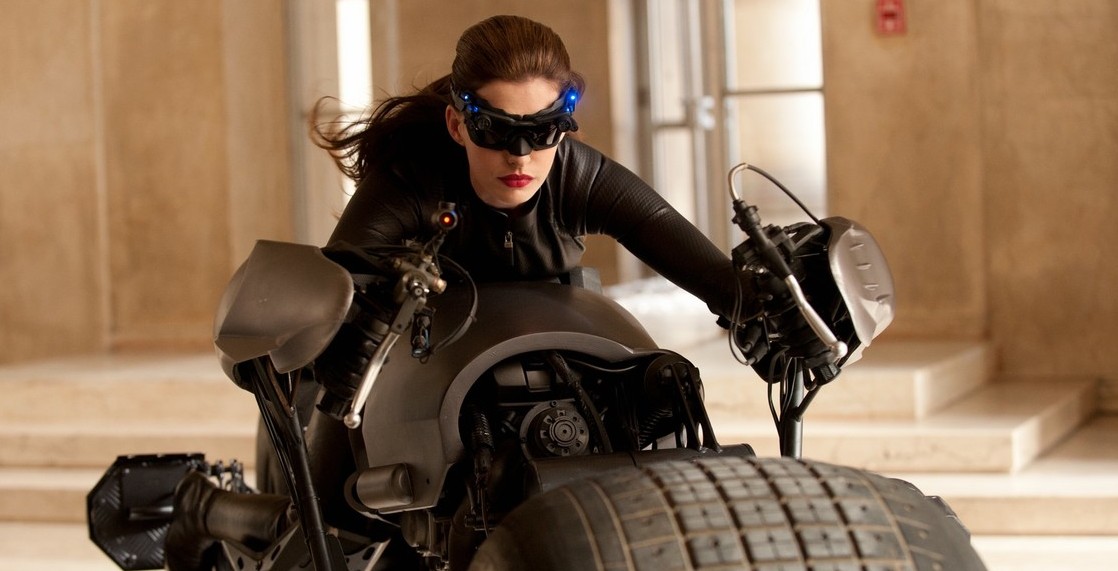
Ah, the predictability of Comics Fans – they complain bitterly if a comic or a character remains the same for too long, and then they complain even more bitterly when someone comes along and does something different. I’ve been largely away from the internets for the last week, but it’s safe to say that there’s been a certain sense of “Huh?” in reaction to the first officially released picture of Anne Hathaway in the role of Selina Kyle, aka Catwoman, from Christopher Nolan’s upcoming ludicrously anticipated third Batman movie The Dark Knight Rises. It’s no surprise to find some people are going “I don’t like it!” and “It looks cheap!” and “Betrayal!” amongst many other reactions – and I have to admit, my first reaction to the picture was (a) good lord, Anne Hathaway looks wonderfully bad-ass in that shot, and (b) It doesn’t look tremendously Catwoman-y, does it?

After all, this is Catwoman we’re talking about – a pretty-much iconic role, one of the major parts of the Batman mythos and a character who’s been the subject of more absurdly sexy and over-the-top comic book art than the brain can comfortably encompass. From the moment it was announced that Selina Kyle was going to be appearing in The Dark Knight Rises, there’s been massive speculation about what sort of look they’d go for, with most people expecting something along the lines of the relatively recent costume redesign courtesy of artist Darwyn Cooke:

Darwyn Cooke Catwoman Art

It’s a look that’s much more practical than the original skin-tight Catwoman suit (and which the Hathaway look actually sticks relatively close to, apart from the fetishy helmet with the cat-ears); it’s a look that’s stuck in the comic books ever since, and is also strongly featured in the upcoming Batman computer game Arkham City (along with a truly insane amount of cleavage). There’s also the jaw-dropping and iconic art from comic artist Adam Hughes, that’s pretty much cemented the idea of what Catwoman’s supposed to look like – (in short, Audrey Hepburn with bigger cleavage):

Catwoman Cover Art Adam Hughes Issue 46 DC Comics

And that’s the version of Catwoman everybody’s used to – confidant, daring, riding the line between heroic and ever-so-slightly-amoral, and unashamed about using her sexuality to get what she wants. A woman who can get away with wearing a catsuit complete with tail and ears, because she’s so goddamed sexy she can get away with it. A woman who’s so cool, that instead of trying to defeat or arrest her, Batman ends up dating her. An icon.

I can understand people looking at the Hathaway photo and being disappointed. I can understand that Catwoman is one of those iconic characters who audiences have major, major expectations for, and if their expectations aren’t met, there’s going to be trouble. And yet, I like the photo. I like the look. I’m still just as excited about The Dark Knight Rises as I was before, and it’s partly because we’re not getting the version of Catwoman we were expecting.

And really, when you stop and think about it, why is anyone surprised by this? The ‘classic’ version of Catwoman is a ridiculously distinctive character, but she’s also very definitely the kind of character who fits best in a comic book universe. In a world where people like Superman, Green Lantern and the Martian Manhunter, it doesn’t seem too unconvincing that a girl might dress up as a cat to aid her life of crime. The most recent version of Catwoman’s origin has her as a prostitute who turned to a life as a costumed criminal to claw her way out of a life she hated, and eventually got herself into the world of the super-rich. She’s even, of course, been a mousy secretary brought back to life by cats and turned into a demented vigilante, in the frankly rather bonkers Batman Returns. And let’s not even talk about the insanely awful horror that was the 2004 Catwoman movie…

But I don’t think any of these iterations of the character would work work comfortably if you just dropped them down in the middle of Christopher Nolan’s version of the Batman mythos. Love them or loathe them (and I know there are plenty who don’t care for Nolan’s Batman movies), both Batman Begins and The Dark Knight give us a rigorously thought out and incredibly grounded version of Batman, to the extent that The Dark Knight frequently feels like a Michael Mann crime thriller where Batman keeps wandering into shot. There’s a deliberate attempt to keep things as real and believable as is possible, and not to throw chunks of the mythology and iconography of the comics in just to please the fans. From the way the Batman costume is introduced to the use of the Joker in The Dark Knight, these are films that are going about their business in a real and serious way – the kookier members of Batman’s rogue’s gallery were automatically out of bounds (Could anyone really see the Mad Hatter or the Riddler making an appearence?), and even the familiar ones were going to be reinterpreted (It’s worth remembering that Heath Ledger’s scar-faced Joker is a bit of a leap from the way the character is normally portrayed).

Basically, I think it was pretty damn unlikely that the wildly sexy, ‘look at me, I’m dressed as a Cat and making sexy cat-noises and I JUST DON’T CARE’ version of Catwoman was ever going to turn up in a Christopher Nolan movie. For better or worse, this is going to be a realer take on the character – it may not be as attention-grabbing or iconic, but it’s what happens when you build a costume to fit the character, rather than moulding a character in order to fit a costume. Plus, it’s what happens when you drop a character like this into a world that’s already strongly laid down after two films – sometimes, the character has to be shaped to fit the world. Another thing that’s important thing to remember – we still have absolutely no idea what kind of Catwoman character we’re actually getting in The Dark Knight Rises, and from the look of this they’re deliberately avoiding the attention-grabbing sexiness, and instead going for what they think a supercool female thief would wear for practical gear (the fact that, as confirmed in other paparazzi-taken photos of a stunt double, she’s wearing flat boots rather than stilleto heels is a very good thing). I’d hazzard a guess that we won’t hear Anne Hathaway say the word “Meow” once. My own personal speculation on this is that this may even be a version of Catwoman who doesn’t even call herself Catwoman – she’s a female cat burglar in a city where a bloke dresses up as a bat; I think it’s perfectly possible a tabloid Gotham newspaper could run a very grainy picture of her crawling across a rooftop with the headline ‘CATWOMAN!’ (A theory I expect to be completely wrong, of course). The point is, anything goes. And they wouldn’t have gone with that costume if there wasn’t a specific reason for it.

Is it as sexy or iconic as the classic Catwoman costume? No it isn’t. But I suspect it’s going to work brilliantly for the character that we are getting in The Dark Knight Rises. Honestly, my first reaction to the costume was similar to my first reaction to Matt Smith’s costume as the Eleventh Doctor Who (a guarded ‘oh’ and a ‘Hmmm… maybe it’ll work’), a look that grew on me to the extent that I now can’t imagine the Eleventh Doctor any other way. Comic fans are a little too used to the ‘But it’s got to look EXACTLY like the printed page otherwise it isn’t real!’ approach – I’ve noticed a similar level of grumbling relating to the new Judge Dredd movie adaptation and its costume redesign, with fans complaining “The helmet looks too big!” and “Hmm, I’ve seen better cosplay costumes”, when Dredd is a $20-30 million indie-produced movie that’s going for a grungier, looser visual adaptation, and simply doesn’t have the budget to make the entire film look exactly like a 2000AD strip. It’s also worth remembering that slavishly following the comic is an approach that doesn’t always work (most recently, in the case of the rather ridiculous Green Lantern costume). Nolan and co are doing something different – and whether or not it works in the final movie, the fact that they’re being daring enough to steer away from the iconic look of a character like Catwoman is something I think should be applauded.

And, finally, there’s two other things to bear in mind:

1: Anne Hathaway still looks damn cool in that picture.

and

2: It could be worse. It could be this:

Catwoman Halle Berry 2004 Movie

*shudder*

Movie Review: Captain America – The First Avenger (2011)

Cast: Chris Evans, Hugo Weaving, Hayley Attwell, Tommy Lee Jones, Dominic Cooper ~ Writers: Christopher Markus, Stephen McFeely ~ Director: Joe Johnston

Captain America The First Avenger Movie Poster 2011 Marvel Studios[xrr rating=3.5/5]

Reviewer: Saxon Bullock (aka @saxonb)

The Lowdown: A likeable dose of old-school pulp adventure, Captain America – The First Avenger takes us back to the 1940s for an introduction to one of Marvel Comics’ biggest characters. The End Result? Action, fights, romance, and a blockbuster that’s simultaneously great fun and a little too lightweight for its own good.

What’s it About?: It’s 1942, and while Nazi-sponsored supervillain Johann Schmidt – aka the Red Skull (Hugo Weaving) – has uncovered an ancient artefact that could grant him unlimited power, wannabe US soldier Steve Rogers (Chris Evans) is still unable to go and fight for his country thanks to his puny frame and weak constitution. But Rogers’ determination leads to him becoming an experimental subject for a Super Soldier serum, and soon the transformed Rogers is becoming the patriotic hero Captain America…

The Story: (Spoiler Alert – it’s extremely difficult to talk about Captain America – The First Avenger without discussing its ending, and how it fits into the wider Marvel Studios shared universe. As a result, if you don’t want to learn details of the ending, consider yourselves warned…)

It’s weirdly refreshing to see a blockbuster that’s so old-school in its approach as Captain America – The First Avenger. Favouring a gentler visual style and a sense of heart and sincerity, this is a long way from the brash swagger of the original Iron Man – but then, Captain America is a long-lived comic character created in a simpler, more optimistic age. In this case, he first appeared as a contemporary wartime comic-book hero written by Joe Simon and drawn by the legendary Jack Kirby back in 1941, and was then revived in the Sixties (thanks to the classic ‘frozen-in-a-block-of-ice’ plot device). The ‘man out of time’ aspect has gone on to become a key part of the character, especially in the acclaimed run written by Ed Brubaker, as well as the character’s appearences in Mark Millar’s The Ultimates (which has ended up as the blueprint for much of Marvel’s celluloid ambitions), but Marvel have surprisingly only given this subplot the minimum amount of screentime here.

Captain America: The First Avenger Chris Evans 2011Instead, what we get is a full-scale origin story for Steve Rogers that harks back to the original Captain America 40s comics (with a certain amount of the Brubaker run), a broad wartime adventure romp of heroic, handsome men battling dastardly villains that also acts as a direct prologue to The Avengers. It’s given a reliably workmanlike and professional handling from director Joe Johnston, a journeyman filmmaker who graduated from special effects work on movies like Raiders of the Lost Ark and the Star Wars Trilogy. Johnston isn’t the most exciting director in the world, but he has trodden the pulp road before in the well-remembered adventure romp The Rocketeer (even if he also perpetuated the pretty damn bad Jurassic Park III), and it serves him in good stead here.

At its best, Captain America captures the fun of good old-fashioned boy’s own adventures, and Johnson’s fun Xeroxed-Spielberg approach is lively and enjoyable (especially in the hugely entertaining montage showing Steve Rogers’ life as a daftly-dressed fund-raising figurehead for the USO), while he handles the demands of a superhero blockbuster far more confidently than Martin Campbell did on Green Lantern. Most important of all, Johnston knows when to give the cast room to act, and coaxes fine performances out of everyone involved, most notably Chris Evans as the all-important title character.

Captain America: The First Avenger Chris Evans Steve Rogers 2011More than most superhero films, Captain America was going to live or die on its casting. It’d be incredibly easy to play such an old-school example of clean-cut, wholesome heroism with a post-modern wink, and some fans were probably expecting exactly that when Evans was cast, considering he’d been previously been best known for his great turn as the wisecracking Johnny Storm in the otherwise lacklustre Fantastic Four movies. It’s to Evans’ credit, then, that he avoids that temptation completely, instead playing the role admirably straight. Where Robert Downey Jr. got a comparitively easy ride as the brash Tony Stark, Evans goes for determined and wholesome beefcake heroism and pulls it off without a hint of mockery or camp (even in the pre-transformation sequences where some not-always-exceptional CGI renders him as a short, spindly weakling).

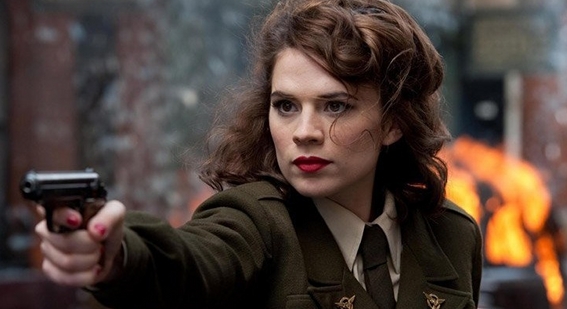
Captain America The First Avenger - Hayley Atwell as Peggy CarterIt’s this mix of earnestness and heart that makes Steve Rogers’s journey from heroic weakling to good-hearted superhuman into a genuinely effective one, aided by efficient action storytelling and strong casting. From Tommy Lee Jones’ streotypically gruff General to Stanley Tucci as the mild-mannered scientist who gives Rogers his chance at heroism, there’s barely a weak link – and there’s also finally a Marvel heroine who’s a strong character in her own right, with Hayley Atwell kicking impressive amounts of arse as Peggy Carter as well as proving to be a thoroughly engaging romantic interest (something which Thor was seriously lacking).

Of course, the down-side of Captain America’s relatively simple, subtext-free origin is that there’s not an awful lot going on here beyond the well-mounted, energetic action sequences. As seems to always happen with wartime-set pulp adventures, there are major echoes of Raiders of the Lost Ark (especially in the mirroring of Steve Rogers and the Red Skull, as different sides of the same superhero coin) but the Raiders comparisons aren’t always deserved, even in terms of the stuntwork, and there are a few too many times when the film’s happy to be a lightweight diversion and absolutely nothing else. Plus, we once again have a Marvel Studios film that’s oddly tentative about its genre – it happened with Thor, which went a bit too far out of its way to tone down the more mythic elements and present Asgard as ‘advanced technology’, and it happens here in a particularly bizarre way.

In short, just over halfway through a film about a World War 2 hero who’s best known for beating up Nazis, Captain America – The First Avenger essentially stops being a WW2 film. The Red Skull’s organisation Hydra is quickly distanced from the Nazi threat (with Schmidt intending on wiping out Hitler along with everyone else) and played more like generic Bond villains (complete with faceless henchmen) than the genuine evil of the Nazis; while, thanks to the Red Skull’s access to advanced Asgardian technology, the 1940s-set story is soon awash with laser cannons, disintegrations, and the kind of modern brushed-steel interior sets you’d normally get in recent blockbusters like G.I. Joe. It all climaxes with a expansive battle Bond-style final battle that owes a serious visual debt to The Spy Who Loved Me (and a brief one to Goldeneye), and the end result is a a film that spends half its time adoring 1940s style and storytelling, and the rest of it shrieking “We’re not making a period film! Honest!”

Hugo Weaving Johann Schmidt The Red Skull Captain America The First Avenger 2011This is especially weird considering the end of the story, where Steve sacrifices himself to save America from destruction – an act that should represent the whole generation who were willing to sacrifice themselves to fight the Nazi threat, but doesn’t carry the power it should simply because the film’s been distancing itself from World War 2 with such determination. There’s also the simple problem that, stripped of the man-out-of-time aspect (which is being saved for The Avengers, and the planned Captain America sequels), we once again get a superhero origin story where the character’s emotional journey is essentially finished 2/3rds of the way through the movie. Thor wasn’t as consistent in terms of pacing, scale and execution, but it was far more engaging in terms of its central character’s emotional journey throughout the film, as well as in its fascinating multi-layered villain. Here, Hugo Weaving does everything he can to make the ludicrously evil Red Skull a charismatic (if two-dimensional) villain, but the conflict between the two characters isn’t strong enough to drive the remainder of the film, and eventually resolves with a head-spinningly bizarre sequence that’s as blatant a piece of “Well, we’ll be seeing him again” storytelling that Marvel have yet pulled off.

By the climax, everything’s in place and Steve Rogers is awake in the 21st Century, but it’s pulled off in a strangely paced sequence that feels more like the opening of the next Captain America story than the climax to this one. It leaves Captain America: The First Avenger feeling a little too much like a prologue, and not enough of a film in its own right, while it’s another Marvel film that once again has the whiff of corporate product about it – it’d certainly be interesting to see Marvel Studios take a couple of steps back and maybe allow a couple of their films more creative freedom rather than micro-managing projects to death. It’s a pity that the flaws in Captain America – The First Avenger mean it doesn’t quite stick in the memory, as it’s got a sense of fun and a lightness of touch that puts it well ahead of the grimmer recent superhero output, and trashes the hell out of misfires like Green Lantern. One thing, however, is for sure – after this nonsensical amount of build-up, Marvel had better have something really special with The Avengers, or there’s going to be trouble…

(A quick note about the much-vaunted post-credit teaser for The Avengers – it’s short. Really, really short. And so quickly edited that it’s mostly impossible to make out. I understand the importance of the slow reveal, but making people wait through the credits for a micro-tease like this isn’t the best intro to actual Avengers footage they could have done…)

The Verdict: Undemanding, lively and fun, Captain America – The First Avenger is a little too lightweight for a WW2-set superhero film, but charming performances and a fun visual style hold it together despite some weird storytelling choices and an uninteresting bad guy. Evans makes an excellent Marvel hero, though, and once The Avengers ride is over, a proper self-contained Captain America movie could be an enticing proposition…

Movie Review: Cars 2 (2011)

Cast (Voices): Owen Wilson, Larry the Cable Guy, Michael Caine, Emily Mortimer, Thomas Kretschmann ~ Writer: Ben Queen ~ Director: John Lasseter

Cars 2 Pixar Animation 2011 John Lasseter Poster[xrr rating=2/5]

Reviewer: Jehan Ranasinghe (aka @Maustallica)

The Low-Down: Pixar’s sequel to its 2006 animated comedy turns out to be the acclaimed studio’s least successful venture to date: a lacklustre and misguided action comedy that struggles to justify its existence on anything beyond a commercial level.

What’s it About?: Champion race car Lightning McQueen (Owen Wilson) has settled into a comfortable life in idyllic Radiator Springs, enjoying time with his best friend Mater the tow truck (Larry the Cable Guy), when he accepts a challenge to compete in the World Grand Prix. Soon, McQueen and pals are embarking on a globetrotting series of race events; however, suspicious circumstances surrounding the races draw the attention of British secret agent Finn McMissile (Michael Caine), setting in motion events that will draw Mater into the dangerous world of international espionage…

The Story: All good things must come to an end. It’s an old saying that often proves true,Cars 2 Pixar Animation 2011 John Lasseter but I think all of us were hoping that somehow Pixar, with their unparalleled track record of critical and commercial smash hits, could be the ones to buck the trend. After all, as of 2010, the Emeryville-based studio had presided over a run of 11 consecutive all-ages classics, redefining feature animation as a medium in the process and inspiring every other major Western animation house to raise their game in order to keep up. So much has been (deservedly) said and written about the studio’s unflinching commitment to quality, creativity and storytelling that it was becoming blissfully easy to believe in a fairytale vision of them as artistically infallible.

That’s why it’s saddening to report that Cars 2 represents the first significant crack in that pristine facade, a technically accomplished but underwhelming film that’s disappointing not only because it’s a failure, but because of the type of failure it is. It would have been almost admirable for Pixar’s golden run to come to an end with an ambitious, overreaching idea that didn’t quite come off, a fate many industry pundits had predicted for conceptually risky projects such as Up, WALL-E and Ratatouille. But it’s hard to make any such argument in defence of Cars 2, a shallow, undercooked movie that says almost nothing and spends an inordinate amount of time doing it.

That this project has resulted in this outcome sadly won’t come as a great surprise to many. The decision to create a sequel to Cars (commonly regarded as the weakest of Pixar’s previous films) was not welcomed with any great enthusiasm, but as a staunch supporter of the original, I was willing to give it the benefit of the doubt – at least, up until the point that the concept was revealed. For all of Cars’ flaws – a slow, deliberate pace and predictable structure among them – it had a deeply personal, surprisingly autumnal message beneath its bright, juvenile exterior. A passion project for director, car enthusiast and Pixar head honcho John Lasseter, the 2006 film was a loving tribute to Route 66, the golden age of American motoring, the sad loss of small-town values and the virtues of slowing down to enjoy the little things in life. That the director chose to follow this with a bombastic spy movie parody – divorced almost entirely from the personality and themes of the original – is a baffling decision, particularly from a studio that so successfully extended and embellished the core emotional fabric of 1995’s Toy Story into a remarkably consistent trilogy.

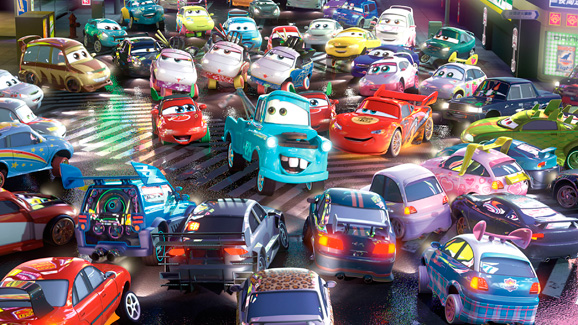
Cars 2 Pixar Animation 2011 John Lasseter The resulting film struggles to define any clear sense of identity or purpose for itself. Lasseter has stated at length that Pixar considers Cars 2 to be a bona fide 1960s-style spy film rather than a parody, but that’s blatantly disingenuous; even leaving aside the fact that the characters are talking vehicles, the slapstick humour and relentlessly flippant tone undermine any pretensions it might have had to being a true genre piece like The Incredibles was. This is as overtly and purely throwaway a comedy as Pixar’s ever produced, its tone defined by lowbrow culture-clash jokes, contrived misunderstandings and vehicular puns both verbal and visual, with Michael Giacchino’s often irritatingly lightweight pastiche score driving it along. If anything, what little effort there is to be genuinely respectful to espionage fiction serves only to undermine the film, as it prevents the script from employing any genuinely subversive material, as well as creating tonally awkward moments of straightfacedness that can’t work in a context that also includes farting tow trucks.

If one were being generous, you could partially excuse Cars 2’s weakness in this regard on the basis that Pixar has never tackled an outright parody before; however, nothing can mitigate or forgive the film’s lapses in terms of characterisation and emotional development, the qualities on which the studio’s glittering reputation is founded. Cars 2 reunites us with almost all of the first film’s major players, while introducing a host of new ones; none of this is to any great effect. As with all good stories, Pixar’s characters work best as conduits through which to explore a central theme; with the exception of a half-hearted and tacked-on moral about (yawn) the importance of friendship and being yourself, Cars 2 simply doesn’t have one, leaving its automotive protagonists to drift aimlessly.

Owen Wilson’s Lightning McQueen saw his character arc completed in the first Cars, and he develops no further here; key supporting players  from the original, most notably love interest Sally Carrera (Bonnie Hunt), are almost insultingly marginalised; meanwhile, new cast additions such as Michael Caine and Emily Mortimer struggle to bring any life to generic characters. However, the sloppiest handling is reserved for redneck truck Mater, unwisely elevated from a comic relief role to that of full-blown protagonist for this sequel. This would be a bad enough idea on its own, but it’s compounded by the fact that he doesn’t really have any particular arc or growth either, remaining a one-note stereotype throughout. US comedian Larry the Cable Guy isn’t everyone’s cup of tea, but he does what he can with the role; ultimately, he’s let down by this material just as much as everyone else is.

Cars 2 Pixar Animation 2011 John Lasseter That a film this problematic was personally directed by someone with as much ability as Lasseter is troubling. After all, this is the man whose unfailing eye for a good story has benefitted not only Pixar, but also played a key role in the recent creative revival of Disney, pulling faltering projects such as Bolt, Tangled and Tinker Bell back on track with a firm and often ruthless hand. It would appear that Lasseter has something of a blind spot as regards the Cars franchise, frequently displaying an enthusiasm for its world and characters that seem at odds with the rather lacklustre reception they receive from wider audiences.

Of course, there is another, more concerning theory: that Cars 2 is a purely commercially motivated cash-in, produced with quality as a secondary concern to the desire to capitalise on the multibillion-dollar merchandising opportunities that have developed around the property. It’s a pessimistic view, and Pixar have shown enough integrity over the years to earn the benefit of the doubt for now. However, with a Monsters Inc. prequel and a rumoured (and seemingly ill-advised) return to the Toy Story franchise among the studio’s forthcoming output, it’s an idea that will be expressed more and more vociferously should the problems of Cars 2 become the rule, rather than an exception.

For the time being, an exception is what Cars 2 is; an exception to 16 years of quality storytelling, multi-generational appeal, sparkling imagination and wit in feature animation. It would be harsh to diagnose terminal creative decline based on this sole failure; at the same time, it would be hypocritical to fail to hold the studio to the high standards it has spent so much time and effort establishing. The world finally knows what a bad Pixar film looks like. Let’s hope never to see another.

The Verdict: Pixar has always had a Midas touch, but on this occasion they simply can’t make gold from a confused, shallow concept that’s tonally at odds with itself, wastes its cast and characters, and ultimately fails to deliver the meaningful experience that the studio has trained us to expect from them.

Comic Review: The League of Extraordinary Gentlemen – Century 1969

Writer: Alan Moore ~ Artist: Kevin O’Neill ~ Colours: Ben Dimagmaliw ~ Publisher: Top Shelf/Knockabout ~ Year: 2011

The League of Extraordinary Gentlemen Century 1969 Cover Art Alan Moore Kevin O'Neill[xrr rating=3.5/5]

Reviewer: Saxon Bullock (aka @saxonb)

The Low-Down: The long-awaited latest volume of Comics Mastermind Alan Moore’s exploration of pulp fiction continues the eccentric course begun with the first instalment of the Century trilogy back in 2009. The League of Extraordinary Gentlemen – Century 1969 is a trippy, explict and disturbing trip through the dark side of the Sixties that’s full of amazing moments, even if it never quite reaches the heights of previous volumes.

What’s it About?: Eleven years after recovering the Black Dossier, the remaining members of the League of Extraordinary Gentlemen – the immortal trio Wilhemina Murray, Allan Quartermain and Orlando – return to the now Swinging London of 1969. There’s evidence that the satanic cult they tracked in 1910 is once again active, and dark forces are linking the worlds of hedonistic pop stars and criminal gangsters. But as one particular rock star aims for a spectacular live performance in Hyde Park, our immortal heroes find themselves in darker danger than they suspected…

The Story: Patience. That’s the main ingredient for being a fan of The League of Extraordinary Gentlemen, a series that’s been published on an increasingly irregular schedule for the last eleven years (a fact that hasn’t been helped by author Alan Moore’s regular run-ins with major comics publishers, resulting in the series being moved from DC imprint Wildstorm to indie publishers Top Shelf and Knockabout). Even with the current trilogy of volumes, what was originally scheduled to be published from 2008-2009 might finally be finished in 2012 if we’re incredibly lucky (although 2013 is probably a safer estimate), but with the infamously outspoken Moore finally stepping away from all mainstream comics work, the LOEG is a project that looks to always follow its own bizarre pace. Moore and O’Neill are going to go at the speed they’re comfortable with, no matter how frustrating it might be.

The League of Extraordinary Gentlemen Century 1969 Panel Art Alan Moore Kevin O'NeillIt probably helps that the LOEG saga has, since the climax of the HG Wells-influenced Volume 2, been gradually stepping away from its Victorian pulp origins, embracing the ludicrous ambition of Volume 2’s head-spinning ‘New Traveller’s Almanac’ text portions, which mapped out an entire world and history based entirely on myth, legend and fiction of all shapes and sizes. Since 2007’s The Black Dossier, the League’s story has been a much stranger one – there’s still the sense of subversive adventure and the overturning of pulp archetypes, but the quest to push into ever weirder and wilder worlds of fiction has given the book a much riskier feel. It’s part romp, part twisted satire, part intellectual treasure-hunt, part spot-the-reference (with every single named character (and plenty of the background extras in certain panels) being a reference to another work of fiction), and since the start of the Century trilogy, things have only got weirder, wilder and more obscure.

This brings us to Century 1969, a volume that gives us the most modern version of the League world yet, crashing us into a brightly coloured and vividly trippy version of Sixties London that melds fiction, music and history into a pretty damn heady brew. While Century 1910 felt closer in tone to Moore’s Martian-centric second volume, this is much closer to The Black Dossier in both style and execution, with Moore taking on a whole series of Sixties-related characters, as well as having to do a lot of careful tiptoeing around certain names in order to avoid major copyright trouble. Featuring a cast of gangsters and drugged-out pop stars, there’s no surprise that there’s a hefty dose of controversial 1970 cult movie Performance and 1971 gangster classic Get Carter in the mix, with Moore’s story build a genuinely unsettling atmosphere as it builds to its mind-bending Hyde Park climax.

There’s all the wit, intelligence and playfulness that you’d expect, along with a predictably bleak and downbeat ending that sets things up for the trilogy’s final volume in a memorable way – and Moore also builds on the seeds laid down in Century 1910, with Mina’s perception of her own immortality once again changing, eventually pushing her in some surprising directions. Underneath the colourful gags, the savage violence and the head-spinning references, there’s a very pointed examination of the Sixties going on here, as well as a look at the way fiction evolves with the times (embodied in Mina’s determinedly ‘groovy’ behaviour). Along with this, there’s a sense of cynical despair at the passage of time and the development of fiction that’s hard not to read as partly thanks to Moore’s disillusionment with most mainstream entertainment (and especially comics and movies).

Thanks to this, Century 1969 may be never less than a fascinating read, but it’s not always a fun one either. A lot of this is simply the level of references – it helps to know a lot about Sixties pop culture (I was especially pleased to see the title character from Adam Adamant Lives! making an appearence), but even then there’s a tremendous amount in Century 1969 that’s pitched at a level you’re never going to appreciate without doing research (or consulting Jess Nevins’ excellent online footnotes, which helped me out with a number of references I’d never have spotted without help). There are points where the story feels in danger of disappearing into the realms of literary/pop culture game, with the danger that it’s very easy for a reader to feel excluded from the moments where they don’t get the joke. Moore doesn’t feel as interested in carrying the reader along for the ride here as he did earlier in the LOEG saga, and there are certain sequences that simply end up perplexing and confusing rather than adventurous and satirical (especially the bizarre scene involving a certain ‘Jack C’ and a moustachioed midget).

The League of Extraordinary Gentlemen Century 1969 Panel Art Alan Moore Kevin O'NeillIt’s partly down to being the flipside of the increasingly offbeat identity of the League saga – no matter how much fun the original two volumes were with their energetic pulp adventure, Moore could easily have run that concept into the ground. Instead, in the exact opposite stance of most mainstream comics (at which Moore aims a couple of subtle barbs during Century 1969), he’s opened it out and changed it so that every single League story is different in style and approach. The League of Extraordinary Gentlemen is still one of the most distinctive, daring and demented cult comic experiences currently available, but Century 1969 has a few too many points where the joke is starting to wear thin, and the chase to keep up with the trail of references and in-jokes gets a little wearing here. Moore is still ploughing his own individualistic furrow, and should be applauded for that – it’s just a pity that he’s not always bringing his audience along for the ride…

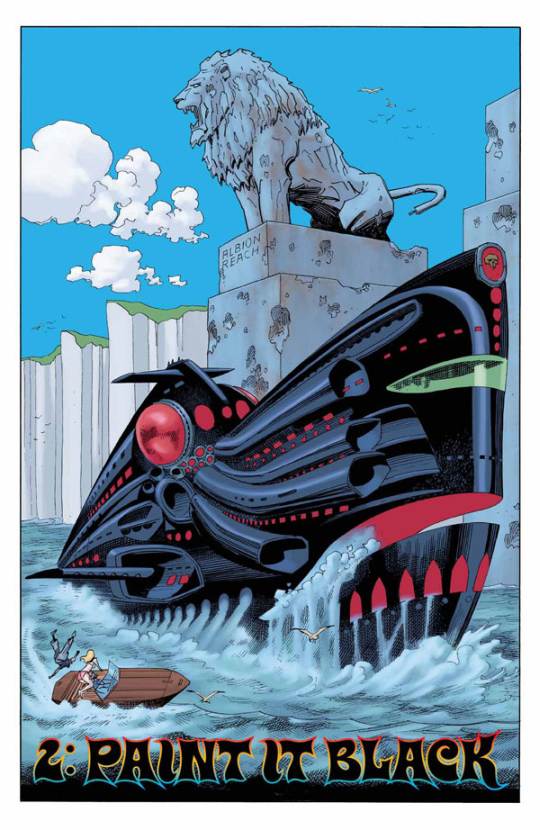
The League of Extraordinary Gentlemen Century 1969 Panel Art Alan Moore Kevin O'NeillThe Art: One area where the League is still as strong as ever, however, is in its visuals. The only artist to ever have his entire artistic style declared ‘objectionable’ by the Comics Code Authority (back in 1986), Kevin O’Neill has a massively distinctive and individual look to his work that’s only gotten crazier over the years. Angular and detailed, his art is closer to the grotesque of old-school English illustrators like Hogarth than traditional superhero comics, and the League has suited him down to the ground from day one, matching Moore’s creativity and imagination note for note. Century 1969 sees him shifting gears again, and from the dour atmospherics of the gangland sequences to the hilariously extreme and imaginative acid trip, it’s breathtaking work that’s strongly backed up with Ben Dimagmaliw’s eye-popping colours. An extra note of applause has to go to Todd Klein, one of the best letterers in the business, who goes to even more imaginative extremes, making this a visually stunning and arresting experience.

The Verdict: Any new readers shouldn’t even consider starting here – The League of Extraordinary Gentlemen – Century 1969 is a distinctive and often extreme tale that won’t be for everyone, and doesn’t quite live up to previous volumes in the series. However, if the mix of pulp adventure, off-beat satire and literary game-play is up your street, then this volume will still give you plenty to chew on – just don’t hold your breath for volume 3, as we may be in for a long wait…

[amtap book:isbn=0861661621]

Movie Review: Harry Potter and the Deathly Hallows – Part 2 (2011)

Cast: Daniel Radcliffe, Emma Watson, Rupert Grint, Ralph Fiennes, Alan Rickman, Michael Gambon  ~ Writer: Steve Kloves ~ Director: David Yates

Harry Potter and the Deathly Hallows Part 2 Movie Poster 2011 Daniel Radcliffe Rupert Grint Emma Watson[xrr rating=4.5/5]

Reviewer: Jehan Ranasinghe (aka @Maustallica)

The Low-Down: The lavish finale to one of the biggest franchises of recent times, Harry Potter and the Deathly Hallows – Part 2 plays with massive stakes and wins big, delivering a fine ending to the Deathly Hallows story and an emotional send-off for the Potter franchise as a whole, as well as being a superbly made film in its own right.

What’s it About?: Things are looking bleak for teenage wizard Harry Potter (Daniel Radcliffe) and his friends: the evil Lord Voldemort (Ralph Fiennes) has acquired the most powerful wand ever to exist and the forces of darkness are closing in. Harry’s only option is to complete his task of locating and destroying the Horcruxes, magical artefacts protecting the Dark Lord’s soul: a mission that will involve a daring bank heist, deadly duels and an all-out war on the grounds of Hogwarts School of Witchcraft and Wizardry, culminating in a final conflict with Voldemort himself. It all ends here…

The Story: (WARNING: No story details in this review will come as a surprise to fans of the book, but anyone who’s managed to stay unspoiled for the last four years may want to tread carefully…)

Let’s make no mistake here: Harry Potter and the Deathly Hallows – Part 2 is a Big Deal.

A lot of films get branded as “event movies” these days; generally, it’s little more than marketing rhetoric, designed to add unwarranted cultural justification to the latest identikit special-effects showcase. Naturally, Warner Bros has been hyping David Yates’ film to the rafters as well, but in this case, its reputation would have preceded it anyway. It’s the direct follow-up to one of 2010’s most successful movies and an adaptation of the fastest-selling novel of all time. It’s also the finale to a cross-media franchise that has produced the highest-grossing film series of all time, one that has been gradually building to this point of payoff for the last decade. It all comes down to this.

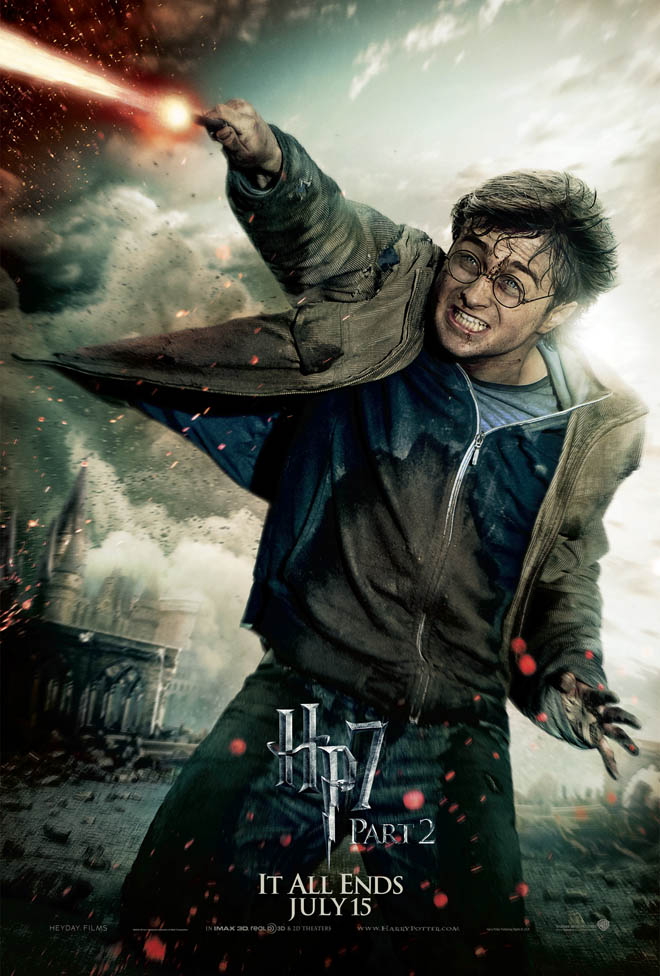
Harry Potter and the Deathly Hallows Part 2 Movie Poster 2011 Daniel RadcliffeNo pressure then, Mr Yates? Judging from the finished product, the answer seems to have been: no, not really. The weight of expectation may have been high, but brush away the hype and you find that Deathly Hallows Part 2 is rock-solid enough to withstand it all. A surprisingly different beast from the quietly excellent Deathly Hallows Part 1, the final Potter is a splendidly-mounted production that knows just how to wrangle its sprawling, challenging source material into something manageable, blending complex lore and grand spectacle with sincere emotion and sombre reflection. It’s reverential enough to please the diehards, while being broad and entertaining enough to convince as a genuine cross-demographic crowd-pleaser. Yates is juggling with an unprecedented number of balls here, yet manages to keep almost all of them in the air, in a way that rarely feels like a great strain.

It could have all turned out so different. I’ll admit to having been hugely sceptical when Warner Bros announced in 2009 their plans to divide JK Rowling’s final Potter tome into two parts, a decision I feared had been made for all the wrong reasons. After all, previous films had done a terrific job of condensing breezeblock-sized tomes such as Goblet of Fire and Order of the Phoenix to manageable lengths; opting against taking the pruning shears to the (admittedly far denser) Deathly Hallows could have ended up as a creative and commercial indulgence, a formless maelstrom of needlessly-included material and meandering pacing. Indeed, such criticisms were aimed by a minority of critics at last year’s Deathly Hallows Part 1, but seeing both halves of the story goes a long way to dismissing these concerns. Part 1 was an equally handsome, well-executed production, but it was burdened by the majority of the book’s expositional heavy lifting and slower, uncinematic passages; as a result of its predecessor’s work, Part 2 is able to give a proper account of the truly climactic and conclusive elements of the story, which are delivered with enough scale, gravitas and forward impetus as to make the entire split feel justified.

Harry Potter and the Deathly Hallows Part 2 Daniel Radcliffe Emma Watson Rupert GrintAdmittedly, there are hiccups along the way. As a film that’s exclusively interested in endings, it’s perhaps predictable that it has trouble finding a way to start, throwing the audience right into the momentum stream of the previous instalment’s finale in a way that’s somewhat disorienting. Deathly Hallows 2 is weakest in an opening half-hour that really doesn’t fit any conventional ideas of a “beginning”; the Gringotts bank raid sequence, though wonderfully realised, has the feel of a loose end from Part 1, while the subsequent meeting with Aberforth Dumbledore (Ciaran Hinds) comes across as a vestigial element from the book, condensing Rowling’s revelations about the hidden past of Michael Gambon’s Albus Dumbledore to the point of inconsequentiality.

Yet once the action returns to Hogwarts in preparation for the all-out war that closes the novel, the film finds its climactic identity, drawing in iconography from the preceding seven films to create lines of symmetry extending through the entire series. The opening Chris Columbus-helmed Potter entries don’t always get a lot of credit, but they did a fairly stellar job of creating a solid architecture within which the more adventurous later films could safely experiment; Deathly Hallows Part 2 clearly recognises this, and spends much of its running time nostalgically venerating that architecture or cathartically dismantling it. The epic good-vs-evil conflict represented by the Battle of Hogwarts is grand enough on its own, but by setting these events against a backdrop of familiar locations such as the Great Hall and the Quidditch stadium falling to ruin, the film is given an easy shorthand method of evoking the end of an era, one that it does not waste. Credit must also go to Alexandre Desplat, returning to scoring duties from Part 1, who makes the sensible decision this time to complement his own accomplished compositions with some of John Williams’ most iconic melodies, restoring a musical consistency to the series that had been on the wane.

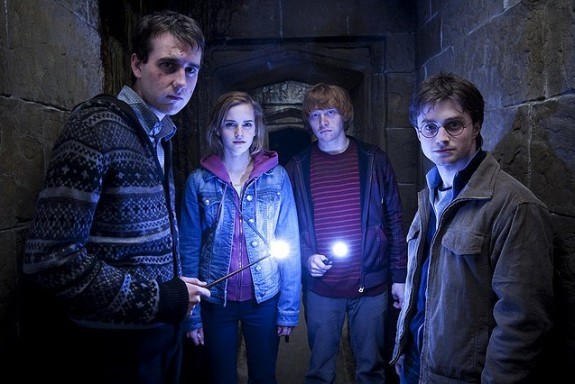
Harry Potter and the Deathly Hallows Part-2 PhotoOf course, there’s more to this series’ lore than castles and chord progression, and while it can’t be said that Yates makes maximum use of the human players in the Harry Potter legend, it’s arguable that he doesn’t need to. After all, Potter is uniquely able to demand anything it requires from the cream of British acting talent – even if “anything” means “nothing” in many cases. Heavyweights such as Gary Oldman, John Hurt, Emma Thompson and Miriam Margolyes are essentially reduced to roles as glorified extras, present only to serve the series’ overall continuity, though the adult cast retains some standouts: notably Alan Rickman, whose Professor Snape delivers one of the most emotionally important moments of the series, and Ralph Fiennes, cutting loose as a Voldemort who becomes tangibly more volatile as his immortal power gradually ebbs away. However, the true lynchpins of Deathly Hallows Part 2 cast are its youngest members, vindicating the remarkable gamble of founding its entire future success of the franchise on the development of a gang of unknown pre-teen actors. Complaints can always be made, but seeing the way Emma Watson, Rupert Grint, Matthew Lewis and especially Daniel Radcliffe have come to occupy and embody Rowling’s characters, it’s hard to see how the choices made back in 2001 could have been paid off significantly better.

Harry Potter and the Deathly Hallows Part 2 Daniel RadcliffeIn the final reckoning, and once the surprisingly effective epilogue scene has faded away, it’s this pleasing correlation between risk and reward that resonates most strongly. The Harry Potter films could have easily ended up as a creatively compromised series of cash-ins; instead, Warner Bros utilised the power of the brand to mount an unprecedented experiment in serialised cinematic narrative, hiring the industry’s best talent to tell a seven-year story in (more or less) real time, while betting millions of dollars on untested children and the outcome of a story that they didn’t even know the ending to when they committed to the project. In an increasingly sterile, risk-averse Hollywood environment, that’s a hell of a bet to make; as critical plaudits and record box-office takings roll in for Deathly Hallows Part 2, it can be concluded that it’s paid off handsomely. Whether we’ll ever see anything like it again is unclear; whether this model could ever produce the same success of Potter is unlikely. The long-term legacy of the Harry Potter movies will only become clear in the coming decades; for now, it’s just worth enjoying the end of a not-always smooth but ultimately satisfying ride.

The Verdict: It’s not easy to bring closure to ten years of swirling plotlines and weighty expectations to a close, but Harry Potter and the Deathly Hallows – Part 2 pulls it off with a minimum of fuss, delivering a satisfying adaptation of a challenging book and hitting all of its climactic marks, while skimping on none of the humour and heart that’s given the series its spark.

[amtap amazon:asin=B0051CBWEU]

[amtap book:isbn=1408810298]

Movie Trailer: The Amazing Spider-Man (2012)

The trailer deluge just keeps on coming, and here we have the first decent look at The Amazing Spider-Man, an upcoming superhero reboot that certainly qualifies as risky. In certain respects, I’m glad they’re rebooting the Spider-Man films – while I enjoyed them, the Raimi films never completely gelled with me, while the third film was an overcrowded and near-incoherent mess, and losing Tobey Maguire and (particularly) Kirsten Dunst didn’t strike me as problems. So, when the original plan for Spider-Man 4 collapsed (and considering that Raimi allegedly wanted John Malkovich as the Vulture, possibly this is a good thing) and Sony went for a full reboot, I was intrigued – especially when they suggested it was going to be much closer to the Ultimate Spider-Man incarnation of the mythos, keeping Peter Parker as a teenage highschooler. (For those not in the know, the ‘Ultimate’ Marvel universe was invented as a way to retell classic Marvel stories in a more contemporary way, although it’s evolved and now stands more as an ‘anything can happen’ alternate to the normal Marvel universe.)

When the director was announced – Marc Webb, a music video director who’s best known for helming offbeat romantic comedy drama 500 Days of Summer – I remained intrigued, especially since he wasn’t a natural choice for a big film, and his hiring definitely suggested they wanted a more modern, relationship-based take on the material. When the casting was announced I was intrigued (and also slightly perplexed when Emma Stone, who would have been absolutely perfect as redheaded Spider-Man girlfriend Mary Jane Watson, instead got cast as a different Spider-Man girlfriend, Gwen Stacey), and I knew the selection of Andrew Garfield in the lead role was definitely a good move even before I saw him in The Social Network. The one thing I was hoping, however, was that we wouldn’t get a full origin again – my fingers were crossed that maybe saner heads would prevail, and we’d get something along the lines of Marvel’s recent take on The Incredible Hulk – giving us the character’s origin in the opening credits, and then straight on with the story.

However, that’s exactly what we’re getting in The Amazing Spider-Man, as this trailer confirms, and while this is a nicely shot (and mostly relationship-heavy) teaser, which certainly looks much more modern and without the slight level of retro-cheese that Raimi added (which was, admittedly, trying to capture some of the tone of the original Stan Lee comics, if not always succesfully), it’s the origin. Again. Only a decade after we first got the origin. There’s a different villain (the less attention-grabbing Lizard aka Curt Conners, played here by Rhys Ifans), but a lot of this is going to play the same to the extent that it’s in danger of feeling more like a remake than a reboot. After all, Spider-Man doesn’t have the same wild variations in tone throughout his history that Batman did, meaning it isn’t as easy to do a stylistic shift like what happened between Batman and Robin and Batman Begins. That was a reboot that justified its existence thoroughly (whatever you thought of the resulting film), whereas this reboot is happening simply because (a) it’s Spidey!! In 3-D!!! and (b) Maguire and Raimi became too pricey (especially considering the mess of the third movie), and Sony need to keep making Spider-Man movies or the rights will switch back to Marvel Studios. Yes, I’m sure that the CG-heavy Spidey POV shot will look great in 3-D, and that Garfield will make an excellent Spider-Man, even if it’s going to be hard dismissing memories of him in The Social Network while watching. I’m also sure that Emma Stone will be much more engaging and less slappable than Dunst was as the female lead (although can anyone explain why, despite blonde being her natural hair colour, she looks so much better (and sexier) as a redhead?). Leaving aside the context, this is a pretty good teaser (and certainly more immediately exciting than the rather low-key, threadbare Dark Knight Rises trailer), and I’ll certainly be there to watch the film in 2012… but until then, they’re going to need to pull something fairly spectacular in order to convince me The Amazing Spider-Man has a better reason to exist than ‘Money, Money, Money’…

Movie Trailer: The Dark Knight Rises (2012)

The Dark Knight Rises Teaser Poster Christopher Nolan 2012 Batman Christian Bale

Despite the collosal trailer deluge of the last week, there was one I was looking forward to more than any others – the first proper glimpse of Christopher Nolan’s upcoming third Batman film, The Dark Knight Rises. Well, it’s finally online at the film’s Facebook page (an official workable embed on this page will, hopefully, be coming soon…), and what are my thoughts? Well… I have to admit that it’s surprisingly low key, and I’m not sure if the accidental echoes of the first trailer for Star Wars Episode 1: The Phantom Menace are a particularly good idea (mainly in the use of captions). However, it’s worth remembering that the first teaser for The Dark Knight was pretty damn low key as well – dialogue from Michael Caine over a disintegrating bat-symbol, followed by a bit of Heath Ledger’s laughter – and this does its job, giving us plenty of old clips, and the very smallest glimpse at where the story of The Dark Knight Rises may be going, with a hospitalised Jim Gordon (Gary Oldman) pleading for Batman’s return (which, I’m assuming from this scene, means that he’s figured out Bruce Wayne is Batman). Plus, a very quick look at Tom Hardy as Bane in full dramatic stomp mode. And that’s our lot. It’s possibly the least intriguing trailer for a Christopher Nolan film that I’ve seen for a very long time, but it’s also the most traditional – and that’s possibly because with so much information flying around (even for someone who’s doing his best to avoid spoilers), it feels like the trailer isn’t really telling me that much I didn’t already know. Whatever happens, though, I’m thoroughly intrigued, and the one-year countdown to the July 2012 release of The Dark Knight Rises starts now…

TV Links: The Doctor Who Tube Map

Doctor Who Tube Map by Crispian Jago

There’s something about the map of the London Underground (aka the Tube) – it’s got such a distinctive visual style that if you apply it to anything else, the results are almost always eyecatching. There’s plenty of examples I can think of over the years, but one of the most fun is here: the interactive Doctor Who Tube Map, which maps out the entire history of Doctor Who with all his villains and adversaries as stops on the London Underground. It’s the creation of Crispian Jago, a freelance IT consultant and self-declared ‘Godless Cornish Git’, and it has to be said that he’s done a splendid job – there are some typos (which apparently have been already highlighted to him on Twitter), but it’s always cool to see this kind of fan project, especially with the level of dedication that needs to go into it to get it right. So – anyone up for a trip to Judoon, taking in Cybermen, Zygons and Arcturus?

Movie Trailer: The Thing (2011)

http://img.widgets.video.s-msn.com/fl/customplayer/current/customplayer.swf

I’ve been intrigued by the idea of this film for a while – it’s a risky idea, but then this does seem to be the era for receiving unexpected sequels/prequels to Eighties films that flopped on release, but built up a major cult reputation in the years that follow. It counts for Tron – but John Carpenter’s version of The Thing is a different kettle of fish, a film that isn’t just remembered well out of nostalgic affection but is a genuinely brilliant, savagely nasty piece of horror filmmaking that was simply not released at the right time. It’s still an amazing piece of work – tense, dark and claustrophobic, and what’s really impressive is exactly how well the truly insane creature effects have stood the test of time, simply thanks to the demented imagination of chief make-up effects guy Rob Bottin. Attempting to even equal that, let alone better it, takes a hell of a lot of nerve – and what we’ve ended up with the 2011 incarnation of The Thing is a rather odd example of a prequel that essentially looks to be a loose remake (in the way that most horror sequels were, back in the Eighties) but which does fit into the timeline of the earlier film, essentially showing us what happened at the Norwegian base where the shape-changing alien monstrosity was first uncovered.

Of course, just to make this even weirder, this means that in certain ways, this’ll actually be closer (at least in its opening sections) to the 1950s original The Thing from Another World, which the Carpenter film itself was a remake of. And, just to make things extra-confusing, they’re basically selling it as a remake and calling it The Thing. Considering it’s a story about an alien that turns itself into what it consumes, all this duplication is probably fitting – the trailer is not bad, and certainly makes clear that they’ve at least well-cast the film, with Mary Elizabeth Winstead looking like a good choice for the lead, and Joel Edgerton being the sort of excellent and rugged-looking character actor that John Carpenter would have stuck in a film back in the Eighties. The screenplay is from Battlestar Galactica mastermind Ronald D. Moore, so there’s at least a good chance that this will be a respectful attempt to measure up to the 1982 original. For fans of the Carpenter film, there’s of course the danger that this could end up as a carbon copy – certain shots in the trailer are note-for-note duplicates of shots from the 1982 original – and the real test is going to be the creature effects, which they’ve sensibly kept under wraps in this trailer. At the least, this could be a fun bit of pastiche that’s actually attempting to capture what made the original great (unlike the Assault on Precinct 13 remake, which completely missed the point), and again it’s amazing to see another under-appreciated gem from my childhood getting a multi-million dollar remake/follow-up. However, it’s going to have to have a lot more than funky visuals, and if it’s a missed opportunity I don’t think anyone’s going to be as forgiving as they were with the fun but deeply flawed Tron: Legacy…

Movie Trailer: John Carter (2012)

Hmmm. That’s my main reaction to the first trailer to John Carter, Disney’s upcoming adaptation of the classic Edgar Rice Burroughs novel A Princess of Mars (the first in the John Carter of Mars series). It’s not a negative hmmm, but it’s not a completely convinced hmmm either, and that’s mainly because this is a project I’m going to have a hard time being objective on. Burroughs’ pulp SF adventures have been massively influential over the years – they don’t quite have the atmosphere and weird poetry of something like Robert E. Howard’s Conan stories, but they’re still a brilliant example of early 20th century high adventure, packed with colour and adventure and one man battling against strange foes. They’re also books that were read to me by my father starting from when I was five years old – we got through almost half the entire series, and so there are chunks of the John Carter saga that are indelibly imprinted on my imagination.

This adaptation has been in the pipeline for decades, and became much more likely with the rise of CG – there was a version with the director of Sky Captain and the World of Tomorrow attached which never happened (and some might say that’s a good thing), while the most recent director to walk was Iron Man helmer Jon Favreau. However, it’s finally happened under the directorial eye of Andrew Stanton, the helmer of Pixar films Finding Nemo and Wall-E, making his live-action debut on a movie that’s also the first live-action Pixar co-production (alongside Disney and – gulp – Jerry Bruckheimer Productions), which is certainly promising (even if, in a fit of nervousness, they’ve lost the ‘of Mars’ from the trailer). And the teaser is intriguing in a whole number of ways, from the lush design to the opening scene that shows they’re keeping the framing device intact – the classic pulp trope of having the tale of wild adventure be a discovered manuscript bequeathed to or discovered by the author. Of course, for anyone who suffered through X-Men Origins: Wolverine, the fact that they’ve cast Taylor Kitsch (aka Gambit) as John Carter and Lynn Collins (aka Wolverine’s immensely forgettable love interest) as Martian princess Deja Thoris is a little less reassuring. Also, it’s not quite as pulpy or as – frankly – Martian as I expected, with a lot of shots looking a bit too Earth-like for my preference (I mean, I know it was shot on location in various US desert areas, but it’d be nice if it looked a bit more alien), while the fragments of dialogue we get here are a tad clunky out of context. This is a teaser, of course, that’s simply out to set the scene and get the 99.99% of the audience who aren’t seriously into Edgar Rice Burroughs adventures excited. I’m going to be really interested to see exactly what they pull off here – my fingers are crossed, but it’s going to take a little more than this to completely blow me away…