Comic Review: The League of Extraordinary Gentlemen – Century 1969

Writer: Alan Moore ~ Artist: Kevin O’Neill ~ Colours: Ben Dimagmaliw ~ Publisher: Top Shelf/Knockabout ~ Year: 2011

The League of Extraordinary Gentlemen Century 1969 Cover Art Alan Moore Kevin O'Neill[xrr rating=3.5/5]

Reviewer: Saxon Bullock (aka @saxonb)

The Low-Down: The long-awaited latest volume of Comics Mastermind Alan Moore’s exploration of pulp fiction continues the eccentric course begun with the first instalment of the Century trilogy back in 2009. The League of Extraordinary Gentlemen – Century 1969 is a trippy, explict and disturbing trip through the dark side of the Sixties that’s full of amazing moments, even if it never quite reaches the heights of previous volumes.

What’s it About?: Eleven years after recovering the Black Dossier, the remaining members of the League of Extraordinary Gentlemen – the immortal trio Wilhemina Murray, Allan Quartermain and Orlando – return to the now Swinging London of 1969. There’s evidence that the satanic cult they tracked in 1910 is once again active, and dark forces are linking the worlds of hedonistic pop stars and criminal gangsters. But as one particular rock star aims for a spectacular live performance in Hyde Park, our immortal heroes find themselves in darker danger than they suspected…

The Story: Patience. That’s the main ingredient for being a fan of The League of Extraordinary Gentlemen, a series that’s been published on an increasingly irregular schedule for the last eleven years (a fact that hasn’t been helped by author Alan Moore’s regular run-ins with major comics publishers, resulting in the series being moved from DC imprint Wildstorm to indie publishers Top Shelf and Knockabout). Even with the current trilogy of volumes, what was originally scheduled to be published from 2008-2009 might finally be finished in 2012 if we’re incredibly lucky (although 2013 is probably a safer estimate), but with the infamously outspoken Moore finally stepping away from all mainstream comics work, the LOEG is a project that looks to always follow its own bizarre pace. Moore and O’Neill are going to go at the speed they’re comfortable with, no matter how frustrating it might be.

The League of Extraordinary Gentlemen Century 1969 Panel Art Alan Moore Kevin O'NeillIt probably helps that the LOEG saga has, since the climax of the HG Wells-influenced Volume 2, been gradually stepping away from its Victorian pulp origins, embracing the ludicrous ambition of Volume 2’s head-spinning ‘New Traveller’s Almanac’ text portions, which mapped out an entire world and history based entirely on myth, legend and fiction of all shapes and sizes. Since 2007’s The Black Dossier, the League’s story has been a much stranger one – there’s still the sense of subversive adventure and the overturning of pulp archetypes, but the quest to push into ever weirder and wilder worlds of fiction has given the book a much riskier feel. It’s part romp, part twisted satire, part intellectual treasure-hunt, part spot-the-reference (with every single named character (and plenty of the background extras in certain panels) being a reference to another work of fiction), and since the start of the Century trilogy, things have only got weirder, wilder and more obscure.

This brings us to Century 1969, a volume that gives us the most modern version of the League world yet, crashing us into a brightly coloured and vividly trippy version of Sixties London that melds fiction, music and history into a pretty damn heady brew. While Century 1910 felt closer in tone to Moore’s Martian-centric second volume, this is much closer to The Black Dossier in both style and execution, with Moore taking on a whole series of Sixties-related characters, as well as having to do a lot of careful tiptoeing around certain names in order to avoid major copyright trouble. Featuring a cast of gangsters and drugged-out pop stars, there’s no surprise that there’s a hefty dose of controversial 1970 cult movie Performance and 1971 gangster classic Get Carter in the mix, with Moore’s story build a genuinely unsettling atmosphere as it builds to its mind-bending Hyde Park climax.
There’s all the wit, intelligence and playfulness that you’d expect, along with a predictably bleak and downbeat ending that sets things up for the trilogy’s final volume in a memorable way – and Moore also builds on the seeds laid down in Century 1910, with Mina’s perception of her own immortality once again changing, eventually pushing her in some surprising directions. Underneath the colourful gags, the savage violence and the head-spinning references, there’s a very pointed examination of the Sixties going on here, as well as a look at the way fiction evolves with the times (embodied in Mina’s determinedly ‘groovy’ behaviour). Along with this, there’s a sense of cynical despair at the passage of time and the development of fiction that’s hard not to read as partly thanks to Moore’s disillusionment with most mainstream entertainment (and especially comics and movies).

Thanks to this, Century 1969 may be never less than a fascinating read, but it’s not always a fun one either. A lot of this is simply the level of references – it helps to know a lot about Sixties pop culture (I was especially pleased to see the title character from Adam Adamant Lives! making an appearence), but even then there’s a tremendous amount in Century 1969 that’s pitched at a level you’re never going to appreciate without doing research (or consulting Jess Nevins’ excellent online footnotes, which helped me out with a number of references I’d never have spotted without help). There are points where the story feels in danger of disappearing into the realms of literary/pop culture game, with the danger that it’s very easy for a reader to feel excluded from the moments where they don’t get the joke. Moore doesn’t feel as interested in carrying the reader along for the ride here as he did earlier in the LOEG saga, and there are certain sequences that simply end up perplexing and confusing rather than adventurous and satirical (especially the bizarre scene involving a certain ‘Jack C’ and a moustachioed midget).

The League of Extraordinary Gentlemen Century 1969 Panel Art Alan Moore Kevin O'NeillIt’s partly down to being the flipside of the increasingly offbeat identity of the League saga – no matter how much fun the original two volumes were with their energetic pulp adventure, Moore could easily have run that concept into the ground. Instead, in the exact opposite stance of most mainstream comics (at which Moore aims a couple of subtle barbs during Century 1969), he’s opened it out and changed it so that every single League story is different in style and approach. The League of Extraordinary Gentlemen is still one of the most distinctive, daring and demented cult comic experiences currently available, but Century 1969 has a few too many points where the joke is starting to wear thin, and the chase to keep up with the trail of references and in-jokes gets a little wearing here. Moore is still ploughing his own individualistic furrow, and should be applauded for that – it’s just a pity that he’s not always bringing his audience along for the ride…

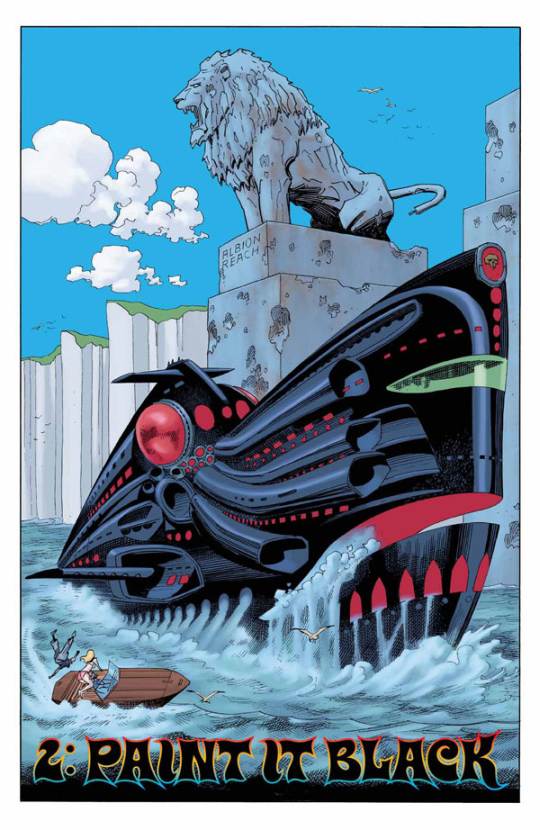
The League of Extraordinary Gentlemen Century 1969 Panel Art Alan Moore Kevin O'NeillThe Art: One area where the League is still as strong as ever, however, is in its visuals. The only artist to ever have his entire artistic style declared ‘objectionable’ by the Comics Code Authority (back in 1986), Kevin O’Neill has a massively distinctive and individual look to his work that’s only gotten crazier over the years. Angular and detailed, his art is closer to the grotesque of old-school English illustrators like Hogarth than traditional superhero comics, and the League has suited him down to the ground from day one, matching Moore’s creativity and imagination note for note. Century 1969 sees him shifting gears again, and from the dour atmospherics of the gangland sequences to the hilariously extreme and imaginative acid trip, it’s breathtaking work that’s strongly backed up with Ben Dimagmaliw’s eye-popping colours. An extra note of applause has to go to Todd Klein, one of the best letterers in the business, who goes to even more imaginative extremes, making this a visually stunning and arresting experience.

The Verdict: Any new readers shouldn’t even consider starting here – The League of Extraordinary Gentlemen – Century 1969 is a distinctive and often extreme tale that won’t be for everyone, and doesn’t quite live up to previous volumes in the series. However, if the mix of pulp adventure, off-beat satire and literary game-play is up your street, then this volume will still give you plenty to chew on – just don’t hold your breath for volume 3, as we may be in for a long wait…

[amtap book:isbn=0861661621]

Movie Review: Harry Potter and the Deathly Hallows – Part 2 (2011)

Cast: Daniel Radcliffe, Emma Watson, Rupert Grint, Ralph Fiennes, Alan Rickman, Michael Gambon  ~ Writer: Steve Kloves ~ Director: David Yates

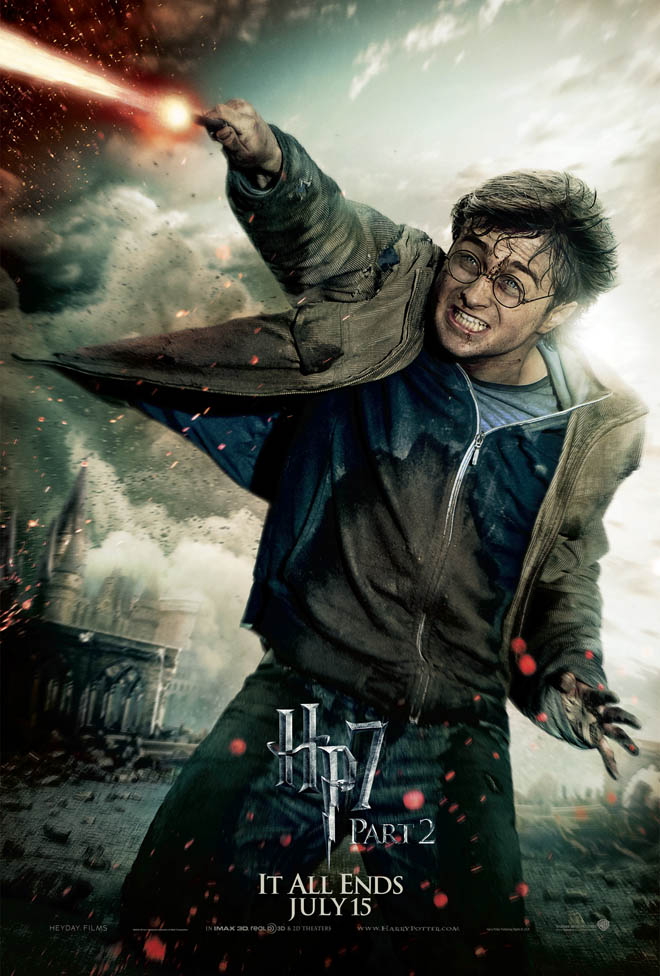
Harry Potter and the Deathly Hallows Part 2 Movie Poster 2011 Daniel Radcliffe Rupert Grint Emma Watson[xrr rating=4.5/5]

Reviewer: Jehan Ranasinghe (aka @Maustallica)

The Low-Down: The lavish finale to one of the biggest franchises of recent times, Harry Potter and the Deathly Hallows – Part 2 plays with massive stakes and wins big, delivering a fine ending to the Deathly Hallows story and an emotional send-off for the Potter franchise as a whole, as well as being a superbly made film in its own right.

What’s it About?: Things are looking bleak for teenage wizard Harry Potter (Daniel Radcliffe) and his friends: the evil Lord Voldemort (Ralph Fiennes) has acquired the most powerful wand ever to exist and the forces of darkness are closing in. Harry’s only option is to complete his task of locating and destroying the Horcruxes, magical artefacts protecting the Dark Lord’s soul: a mission that will involve a daring bank heist, deadly duels and an all-out war on the grounds of Hogwarts School of Witchcraft and Wizardry, culminating in a final conflict with Voldemort himself. It all ends here…

The Story: (WARNING: No story details in this review will come as a surprise to fans of the book, but anyone who’s managed to stay unspoiled for the last four years may want to tread carefully…)

Let’s make no mistake here: Harry Potter and the Deathly Hallows – Part 2 is a Big Deal.

A lot of films get branded as “event movies” these days; generally, it’s little more than marketing rhetoric, designed to add unwarranted cultural justification to the latest identikit special-effects showcase. Naturally, Warner Bros has been hyping David Yates’ film to the rafters as well, but in this case, its reputation would have preceded it anyway. It’s the direct follow-up to one of 2010’s most successful movies and an adaptation of the fastest-selling novel of all time. It’s also the finale to a cross-media franchise that has produced the highest-grossing film series of all time, one that has been gradually building to this point of payoff for the last decade. It all comes down to this.

Harry Potter and the Deathly Hallows Part 2 Movie Poster 2011 Daniel RadcliffeNo pressure then, Mr Yates? Judging from the finished product, the answer seems to have been: no, not really. The weight of expectation may have been high, but brush away the hype and you find that Deathly Hallows Part 2 is rock-solid enough to withstand it all. A surprisingly different beast from the quietly excellent Deathly Hallows Part 1, the final Potter is a splendidly-mounted production that knows just how to wrangle its sprawling, challenging source material into something manageable, blending complex lore and grand spectacle with sincere emotion and sombre reflection. It’s reverential enough to please the diehards, while being broad and entertaining enough to convince as a genuine cross-demographic crowd-pleaser. Yates is juggling with an unprecedented number of balls here, yet manages to keep almost all of them in the air, in a way that rarely feels like a great strain.

It could have all turned out so different. I’ll admit to having been hugely sceptical when Warner Bros announced in 2009 their plans to divide JK Rowling’s final Potter tome into two parts, a decision I feared had been made for all the wrong reasons. After all, previous films had done a terrific job of condensing breezeblock-sized tomes such as Goblet of Fire and Order of the Phoenix to manageable lengths; opting against taking the pruning shears to the (admittedly far denser) Deathly Hallows could have ended up as a creative and commercial indulgence, a formless maelstrom of needlessly-included material and meandering pacing. Indeed, such criticisms were aimed by a minority of critics at last year’s Deathly Hallows Part 1, but seeing both halves of the story goes a long way to dismissing these concerns. Part 1 was an equally handsome, well-executed production, but it was burdened by the majority of the book’s expositional heavy lifting and slower, uncinematic passages; as a result of its predecessor’s work, Part 2 is able to give a proper account of the truly climactic and conclusive elements of the story, which are delivered with enough scale, gravitas and forward impetus as to make the entire split feel justified.

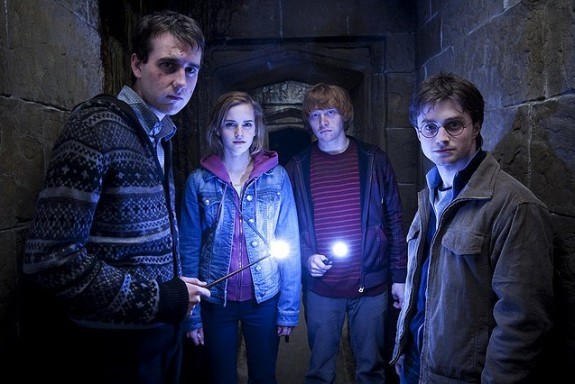
Harry Potter and the Deathly Hallows Part 2 Daniel Radcliffe Emma Watson Rupert GrintAdmittedly, there are hiccups along the way. As a film that’s exclusively interested in endings, it’s perhaps predictable that it has trouble finding a way to start, throwing the audience right into the momentum stream of the previous instalment’s finale in a way that’s somewhat disorienting. Deathly Hallows 2 is weakest in an opening half-hour that really doesn’t fit any conventional ideas of a “beginning”; the Gringotts bank raid sequence, though wonderfully realised, has the feel of a loose end from Part 1, while the subsequent meeting with Aberforth Dumbledore (Ciaran Hinds) comes across as a vestigial element from the book, condensing Rowling’s revelations about the hidden past of Michael Gambon’s Albus Dumbledore to the point of inconsequentiality.

Yet once the action returns to Hogwarts in preparation for the all-out war that closes the novel, the film finds its climactic identity, drawing in iconography from the preceding seven films to create lines of symmetry extending through the entire series. The opening Chris Columbus-helmed Potter entries don’t always get a lot of credit, but they did a fairly stellar job of creating a solid architecture within which the more adventurous later films could safely experiment; Deathly Hallows Part 2 clearly recognises this, and spends much of its running time nostalgically venerating that architecture or cathartically dismantling it. The epic good-vs-evil conflict represented by the Battle of Hogwarts is grand enough on its own, but by setting these events against a backdrop of familiar locations such as the Great Hall and the Quidditch stadium falling to ruin, the film is given an easy shorthand method of evoking the end of an era, one that it does not waste. Credit must also go to Alexandre Desplat, returning to scoring duties from Part 1, who makes the sensible decision this time to complement his own accomplished compositions with some of John Williams’ most iconic melodies, restoring a musical consistency to the series that had been on the wane.

Harry Potter and the Deathly Hallows Part-2 PhotoOf course, there’s more to this series’ lore than castles and chord progression, and while it can’t be said that Yates makes maximum use of the human players in the Harry Potter legend, it’s arguable that he doesn’t need to. After all, Potter is uniquely able to demand anything it requires from the cream of British acting talent – even if “anything” means “nothing” in many cases. Heavyweights such as Gary Oldman, John Hurt, Emma Thompson and Miriam Margolyes are essentially reduced to roles as glorified extras, present only to serve the series’ overall continuity, though the adult cast retains some standouts: notably Alan Rickman, whose Professor Snape delivers one of the most emotionally important moments of the series, and Ralph Fiennes, cutting loose as a Voldemort who becomes tangibly more volatile as his immortal power gradually ebbs away. However, the true lynchpins of Deathly Hallows Part 2 cast are its youngest members, vindicating the remarkable gamble of founding its entire future success of the franchise on the development of a gang of unknown pre-teen actors. Complaints can always be made, but seeing the way Emma Watson, Rupert Grint, Matthew Lewis and especially Daniel Radcliffe have come to occupy and embody Rowling’s characters, it’s hard to see how the choices made back in 2001 could have been paid off significantly better.

Harry Potter and the Deathly Hallows Part 2 Daniel RadcliffeIn the final reckoning, and once the surprisingly effective epilogue scene has faded away, it’s this pleasing correlation between risk and reward that resonates most strongly. The Harry Potter films could have easily ended up as a creatively compromised series of cash-ins; instead, Warner Bros utilised the power of the brand to mount an unprecedented experiment in serialised cinematic narrative, hiring the industry’s best talent to tell a seven-year story in (more or less) real time, while betting millions of dollars on untested children and the outcome of a story that they didn’t even know the ending to when they committed to the project. In an increasingly sterile, risk-averse Hollywood environment, that’s a hell of a bet to make; as critical plaudits and record box-office takings roll in for Deathly Hallows Part 2, it can be concluded that it’s paid off handsomely. Whether we’ll ever see anything like it again is unclear; whether this model could ever produce the same success of Potter is unlikely. The long-term legacy of the Harry Potter movies will only become clear in the coming decades; for now, it’s just worth enjoying the end of a not-always smooth but ultimately satisfying ride.

The Verdict: It’s not easy to bring closure to ten years of swirling plotlines and weighty expectations to a close, but Harry Potter and the Deathly Hallows – Part 2 pulls it off with a minimum of fuss, delivering a satisfying adaptation of a challenging book and hitting all of its climactic marks, while skimping on none of the humour and heart that’s given the series its spark.

[amtap amazon:asin=B0051CBWEU]

[amtap book:isbn=1408810298]

Movie Trailer: The Amazing Spider-Man (2012)

The trailer deluge just keeps on coming, and here we have the first decent look at The Amazing Spider-Man, an upcoming superhero reboot that certainly qualifies as risky. In certain respects, I’m glad they’re rebooting the Spider-Man films – while I enjoyed them, the Raimi films never completely gelled with me, while the third film was an overcrowded and near-incoherent mess, and losing Tobey Maguire and (particularly) Kirsten Dunst didn’t strike me as problems. So, when the original plan for Spider-Man 4 collapsed (and considering that Raimi allegedly wanted John Malkovich as the Vulture, possibly this is a good thing) and Sony went for a full reboot, I was intrigued – especially when they suggested it was going to be much closer to the Ultimate Spider-Man incarnation of the mythos, keeping Peter Parker as a teenage highschooler. (For those not in the know, the ‘Ultimate’ Marvel universe was invented as a way to retell classic Marvel stories in a more contemporary way, although it’s evolved and now stands more as an ‘anything can happen’ alternate to the normal Marvel universe.)

When the director was announced – Marc Webb, a music video director who’s best known for helming offbeat romantic comedy drama 500 Days of Summer – I remained intrigued, especially since he wasn’t a natural choice for a big film, and his hiring definitely suggested they wanted a more modern, relationship-based take on the material. When the casting was announced I was intrigued (and also slightly perplexed when Emma Stone, who would have been absolutely perfect as redheaded Spider-Man girlfriend Mary Jane Watson, instead got cast as a different Spider-Man girlfriend, Gwen Stacey), and I knew the selection of Andrew Garfield in the lead role was definitely a good move even before I saw him in The Social Network. The one thing I was hoping, however, was that we wouldn’t get a full origin again – my fingers were crossed that maybe saner heads would prevail, and we’d get something along the lines of Marvel’s recent take on The Incredible Hulk – giving us the character’s origin in the opening credits, and then straight on with the story.

However, that’s exactly what we’re getting in The Amazing Spider-Man, as this trailer confirms, and while this is a nicely shot (and mostly relationship-heavy) teaser, which certainly looks much more modern and without the slight level of retro-cheese that Raimi added (which was, admittedly, trying to capture some of the tone of the original Stan Lee comics, if not always succesfully), it’s the origin. Again. Only a decade after we first got the origin. There’s a different villain (the less attention-grabbing Lizard aka Curt Conners, played here by Rhys Ifans), but a lot of this is going to play the same to the extent that it’s in danger of feeling more like a remake than a reboot. After all, Spider-Man doesn’t have the same wild variations in tone throughout his history that Batman did, meaning it isn’t as easy to do a stylistic shift like what happened between Batman and Robin and Batman Begins. That was a reboot that justified its existence thoroughly (whatever you thought of the resulting film), whereas this reboot is happening simply because (a) it’s Spidey!! In 3-D!!! and (b) Maguire and Raimi became too pricey (especially considering the mess of the third movie), and Sony need to keep making Spider-Man movies or the rights will switch back to Marvel Studios. Yes, I’m sure that the CG-heavy Spidey POV shot will look great in 3-D, and that Garfield will make an excellent Spider-Man, even if it’s going to be hard dismissing memories of him in The Social Network while watching. I’m also sure that Emma Stone will be much more engaging and less slappable than Dunst was as the female lead (although can anyone explain why, despite blonde being her natural hair colour, she looks so much better (and sexier) as a redhead?). Leaving aside the context, this is a pretty good teaser (and certainly more immediately exciting than the rather low-key, threadbare Dark Knight Rises trailer), and I’ll certainly be there to watch the film in 2012… but until then, they’re going to need to pull something fairly spectacular in order to convince me The Amazing Spider-Man has a better reason to exist than ‘Money, Money, Money’…

Movie Trailer: The Dark Knight Rises (2012)

The Dark Knight Rises Teaser Poster Christopher Nolan 2012 Batman Christian Bale

Despite the collosal trailer deluge of the last week, there was one I was looking forward to more than any others – the first proper glimpse of Christopher Nolan’s upcoming third Batman film, The Dark Knight Rises. Well, it’s finally online at the film’s Facebook page (an official workable embed on this page will, hopefully, be coming soon…), and what are my thoughts? Well… I have to admit that it’s surprisingly low key, and I’m not sure if the accidental echoes of the first trailer for Star Wars Episode 1: The Phantom Menace are a particularly good idea (mainly in the use of captions). However, it’s worth remembering that the first teaser for The Dark Knight was pretty damn low key as well – dialogue from Michael Caine over a disintegrating bat-symbol, followed by a bit of Heath Ledger’s laughter – and this does its job, giving us plenty of old clips, and the very smallest glimpse at where the story of The Dark Knight Rises may be going, with a hospitalised Jim Gordon (Gary Oldman) pleading for Batman’s return (which, I’m assuming from this scene, means that he’s figured out Bruce Wayne is Batman). Plus, a very quick look at Tom Hardy as Bane in full dramatic stomp mode. And that’s our lot. It’s possibly the least intriguing trailer for a Christopher Nolan film that I’ve seen for a very long time, but it’s also the most traditional – and that’s possibly because with so much information flying around (even for someone who’s doing his best to avoid spoilers), it feels like the trailer isn’t really telling me that much I didn’t already know. Whatever happens, though, I’m thoroughly intrigued, and the one-year countdown to the July 2012 release of The Dark Knight Rises starts now…

TV Links: The Doctor Who Tube Map

Doctor Who Tube Map by Crispian Jago

There’s something about the map of the London Underground (aka the Tube) – it’s got such a distinctive visual style that if you apply it to anything else, the results are almost always eyecatching. There’s plenty of examples I can think of over the years, but one of the most fun is here: the interactive Doctor Who Tube Map, which maps out the entire history of Doctor Who with all his villains and adversaries as stops on the London Underground. It’s the creation of Crispian Jago, a freelance IT consultant and self-declared ‘Godless Cornish Git’, and it has to be said that he’s done a splendid job – there are some typos (which apparently have been already highlighted to him on Twitter), but it’s always cool to see this kind of fan project, especially with the level of dedication that needs to go into it to get it right. So – anyone up for a trip to Judoon, taking in Cybermen, Zygons and Arcturus?

Movie Trailer: The Thing (2011)

http://img.widgets.video.s-msn.com/fl/customplayer/current/customplayer.swf

I’ve been intrigued by the idea of this film for a while – it’s a risky idea, but then this does seem to be the era for receiving unexpected sequels/prequels to Eighties films that flopped on release, but built up a major cult reputation in the years that follow. It counts for Tron – but John Carpenter’s version of The Thing is a different kettle of fish, a film that isn’t just remembered well out of nostalgic affection but is a genuinely brilliant, savagely nasty piece of horror filmmaking that was simply not released at the right time. It’s still an amazing piece of work – tense, dark and claustrophobic, and what’s really impressive is exactly how well the truly insane creature effects have stood the test of time, simply thanks to the demented imagination of chief make-up effects guy Rob Bottin. Attempting to even equal that, let alone better it, takes a hell of a lot of nerve – and what we’ve ended up with the 2011 incarnation of The Thing is a rather odd example of a prequel that essentially looks to be a loose remake (in the way that most horror sequels were, back in the Eighties) but which does fit into the timeline of the earlier film, essentially showing us what happened at the Norwegian base where the shape-changing alien monstrosity was first uncovered.

Of course, just to make this even weirder, this means that in certain ways, this’ll actually be closer (at least in its opening sections) to the 1950s original The Thing from Another World, which the Carpenter film itself was a remake of. And, just to make things extra-confusing, they’re basically selling it as a remake and calling it The Thing. Considering it’s a story about an alien that turns itself into what it consumes, all this duplication is probably fitting – the trailer is not bad, and certainly makes clear that they’ve at least well-cast the film, with Mary Elizabeth Winstead looking like a good choice for the lead, and Joel Edgerton being the sort of excellent and rugged-looking character actor that John Carpenter would have stuck in a film back in the Eighties. The screenplay is from Battlestar Galactica mastermind Ronald D. Moore, so there’s at least a good chance that this will be a respectful attempt to measure up to the 1982 original. For fans of the Carpenter film, there’s of course the danger that this could end up as a carbon copy – certain shots in the trailer are note-for-note duplicates of shots from the 1982 original – and the real test is going to be the creature effects, which they’ve sensibly kept under wraps in this trailer. At the least, this could be a fun bit of pastiche that’s actually attempting to capture what made the original great (unlike the Assault on Precinct 13 remake, which completely missed the point), and again it’s amazing to see another under-appreciated gem from my childhood getting a multi-million dollar remake/follow-up. However, it’s going to have to have a lot more than funky visuals, and if it’s a missed opportunity I don’t think anyone’s going to be as forgiving as they were with the fun but deeply flawed Tron: Legacy…

Movie Trailer: John Carter (2012)

Hmmm. That’s my main reaction to the first trailer to John Carter, Disney’s upcoming adaptation of the classic Edgar Rice Burroughs novel A Princess of Mars (the first in the John Carter of Mars series). It’s not a negative hmmm, but it’s not a completely convinced hmmm either, and that’s mainly because this is a project I’m going to have a hard time being objective on. Burroughs’ pulp SF adventures have been massively influential over the years – they don’t quite have the atmosphere and weird poetry of something like Robert E. Howard’s Conan stories, but they’re still a brilliant example of early 20th century high adventure, packed with colour and adventure and one man battling against strange foes. They’re also books that were read to me by my father starting from when I was five years old – we got through almost half the entire series, and so there are chunks of the John Carter saga that are indelibly imprinted on my imagination.

This adaptation has been in the pipeline for decades, and became much more likely with the rise of CG – there was a version with the director of Sky Captain and the World of Tomorrow attached which never happened (and some might say that’s a good thing), while the most recent director to walk was Iron Man helmer Jon Favreau. However, it’s finally happened under the directorial eye of Andrew Stanton, the helmer of Pixar films Finding Nemo and Wall-E, making his live-action debut on a movie that’s also the first live-action Pixar co-production (alongside Disney and – gulp – Jerry Bruckheimer Productions), which is certainly promising (even if, in a fit of nervousness, they’ve lost the ‘of Mars’ from the trailer). And the teaser is intriguing in a whole number of ways, from the lush design to the opening scene that shows they’re keeping the framing device intact – the classic pulp trope of having the tale of wild adventure be a discovered manuscript bequeathed to or discovered by the author. Of course, for anyone who suffered through X-Men Origins: Wolverine, the fact that they’ve cast Taylor Kitsch (aka Gambit) as John Carter and Lynn Collins (aka Wolverine’s immensely forgettable love interest) as Martian princess Deja Thoris is a little less reassuring. Also, it’s not quite as pulpy or as – frankly – Martian as I expected, with a lot of shots looking a bit too Earth-like for my preference (I mean, I know it was shot on location in various US desert areas, but it’d be nice if it looked a bit more alien), while the fragments of dialogue we get here are a tad clunky out of context. This is a teaser, of course, that’s simply out to set the scene and get the 99.99% of the audience who aren’t seriously into Edgar Rice Burroughs adventures excited. I’m going to be really interested to see exactly what they pull off here – my fingers are crossed, but it’s going to take a little more than this to completely blow me away…

Movie News: Cities! Explosions! Abstraction! The Dark Knight Rises teaser poster arrives!

It’s started. So far, Christopher Nolan’s third Batman film The Dark Knight Rises has been proceeding in the usual state of near-lockdown that he always seems to manage. We’ve seen an official picture of Tom Hardy as Bane, we’ve gotten a whole selection of casting news… and that’s been about it. Well, there are strong rumours that a first teaser trailer will appear on the front of the final Harry Potter movie this week, and now we’ve got the first Dark Knight Rises teaser poster. And they’ve certainly stuck with the abstract route – it’s attention-grabbing, very Inception-like, and certainly seems to be saying that no matter how positive the title may sound, Gotham is going to be taking a serious pounding. I’m not expecting the teaser trailer to tell me much more than this, and I’m perfectly happy that way – one of the reasons Inception was so much fun was that I simply didn’t know that much about it when I went into the cinema, and the trailers were brilliant examples of being intriguing while telling the minimal amount of detail. Whichever way the publicity for Dark Knight Rises goes, Summer 2012 still feels like a long way away…

The Dark Knight Rises Teaser Poster Christopher Nolan 2012 Batman Christian Bale

Movie Review: Transformers: Dark of the Moon (2011)

Cast: Shia LaBeouf, Josh Duhamel, John Turturro, Tyrese Gibson, Rosie Huntington-Whiteley ~ Writer: Ehren Kruger ~ Director: Michael Bay

Transformers 3 Dark of the Moon Movie Poster Michael Bay Shia LaBeouf[xrr rating=2.5/5]

Reviewer: Jehan Ranasinghe (aka @Maustallica)

The Low-Down: The third in Michael Bay’s profitable yet reviled series of action figure-inspired blockbusters, Transformers: Dark of the Moon is a swaggering, belligerent buffet of summer spectacle that’s as sure to please its core audience as it is to alienate and anger everyone else. Non-believers need not apply.

What’s it About?: With Optimus Prime and the heroic Autobots enshrined as protectors of Earth, human ally Sam Witwicky (Shia LaBeouf) is having trouble finding a job and adjusting to the demands of a normal life. But trouble is on the way for both parties when Cybertronian technology is found on the Moon: a discovery that leads to the uncovering of a decades-old conspiracy, the return of a legendary Autobot hero, and a full-scale invasion of Earth…

The Story: Michael Bay cannot be stopped.

That’s the thought that occurs when stepping out of Transformers: Dark of the Moon, ostensibly a commercially-driven, wide-appeal action movie, but one which turns out to be a towering $200 million edifice carved in the director’s own image. After all, this was supposed to the movie that saw Bay returning cap in hand after the critical mauling of Transformers: Revenge of the Fallen, a film that had its coherence torpedoed by the2007-08 Writers Guild of America strike, and which the director himself has admitted was “crap”. Pre-release talk for TF3 has been awash with pledges to right the wrongs of that misbegotten mess, to make amends, to learn lessons.

As it turns out, the very last thing that Dark of the Moon can be described as is “contrite”. Simply put, this is exactly the same kind of excess-riddled orgy that’s defined Bay’s career, but blown up to a scale that feels like an act of deliberate defiance. It takes every element you’d expect from a Big Dumb Action Movie and feeds you an unending supply; by turns, Transformers 3 is a sci-fi potboiler, a comic-book movie, a frat-boy comedy, a 1980s kids’ cartoon, a war film, a music video, a car commercial and everything in between. In IMAX 3D. Sensory overload doesn’t begin to cover it.

Bay’s vision is almost admirable in some ways. There’s an insanely single-minded drive throughout this series to deliver the absolute maximum amount of entertainment per second as possible, but Bay simply doesn’t have the word “stop” in his vocabulary; he keeps dropping more and more into the mix, until you’re left with the cinematic equivalent of a Christmas pudding-flavoured gateaux encased in chocolate and coated in Pringles. Money shot follows money shot, comedy sidekicks have their own comedy sidekicks, while the final hour – chronicling a massive-scale Decepticon invasion of Chicago – is essentially one long, mad, escalating action sequence.

Transformers Dark of the Moon Shia LaBeouf Rose Huntington-Whitley Michael bayOf course, the major issue here is not that the film tries to entertain; it’s the commitment to Michael Bay’s definition of “entertaining”, which can be extremely abrasive to anyone lacking his testosteronal sensibilities. Bay’s Transformers universe is an aggressively masculine wonderland of explosions, brutal violence, lasciviously-filmed cars and women and a juvenile, stereotype-loving approach to comedy, which will clearly rankle with a great many audience members. There’s nothing as show-stoppingly sophomoric as the leg-humping, testicle-endowed robots of Revenge of the Fallen, but there’s still enough of an abundance of effete Germans, Asians named “Deep Wang” and screaming, perma-tanned John Malkoviches to cause pain.

So Dark of the Moon is riddled with easily foreseeable flaws? Well, of course. But honestly? I get the feeling that this is exactly the movie that Michael Bay set out to make. Transformers 2 was the one that got away from him; part 3, on the other hand, is clearly the work of a director at the top of his game – regardless of whether or not that’s a game you’re interested in playing. It’s interesting to compare this to something like, say, the recent Green Lantern – neither movie has been warmly received, but where Lantern was a confused, mumbling, deflated excuse for a film, Dark of the Moon has a strutting, unthinking arrogance and confidence that demands your attention, if not your approval. It believes in its vision and doesn’t much care if you disagree.

It’s a belief that manifests itself, for example, in the casting, which wheels out a procession of big-name stars who are surely here for the paycheque – Malkovich, Frances McDormand, John Turturro, Patrick Dempsey – but who nevertheless refuse to phone it in, annihilating the scenery with the same indecent ferocity as Bay himself. It’s also evident in the sheer scale of the action choreography, which renders toppling skyscrapers, shape-shifting freeway chases, vertiginous wingsuit flight sequences and scenes of city-spanning urban destruction with obscene levels of care and expense, all rendered in top-quality 3D.

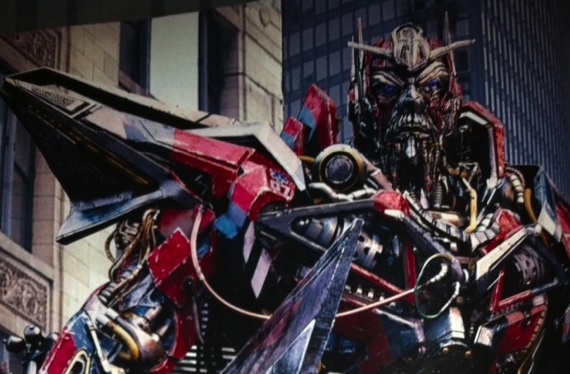
Transformers 3 Dark of the Moon Michael Bay ShockwaveWhat underpins this confidence, ultimately, is Bay’s knowledge that he has succeeded delivered a far better film than Revenge of the Fallen, for all that’s worth. Partially, this is due to refinements in his own directorial style – possibly due to the demands of the 3D cameras – that see him slowing down his frenetic editing to deliver sharp, clear and balletic action sequences. But primarily, it’s due to the fact that this film has the advantage of an overall story structure that actually makes sense, delivering the hokey but fun alien conspiracy/invasion tale that Transformers 2 tried and failed to convey. It’s certainly no masterpiece, but the presence of a clear three-act structure – even a ludicrously flabby one – does help to contextualise the robot mayhem, even enabling a couple of reasonably surprising twists. Of course, Bay being Bay, enjoyment of Transformers: Dark of the Moon’s story is dependent on your ability to overlook a number of gaping logic holes, but it’s still streets ahead of Revenge of the Fallen, which featured a plot that wouldn’t stand up to a stiff breeze. It’s also dependent on you not having grown tired of Shia LaBeouf’s fast-talking shouty everyguy schtick, which is often dialed up to unpalatable extremes, although while the new scantily clad, absurdly over-attractive female lead Rosie Huntington-Whitely (replacing terminally outspoken Transformers 1+2 star Megan Fox) won’t be winning any acting awards, she also doesn’t disgrace herself either with a performance that’s nowhere near as horrendous as some of her harsher critics would have you believe.

Transformers 3 Dark of the Moon Sentinel Prime Michael BayStill, if there’s one prevailing and crucial failing that’s never really addressed, it’s the limited role played by the Transformers themselves in all of this. Bay made a virtue of keeping them hidden for most of his original 2007 Transformers film, instilling the robots with a sense of awe and wonder; since making that reveal, he’s seemed unsure of what to do with them, and has disappointingly settled on using them as walking setpieces, rather than actual characters. The Transformers canon can be a messy and disparate affair, but there are still plenty of strong personalities among the Autobot and Decepticon rosters that never get a look-in here. Dark of the Moon has the most robot-to-robot interactions of the series, but most ‘bot characters barely qualify as one-dimensional – the notoriously treacherous Decepticon lieutenant Starscream, for example, doesn’t do any backstabbing in the whole trilogy, while the much-hyped antagonist Shockwave is a red herring non-event. Those with the screentime to impose themselves, meanwhile, often fall victim to misuse and misinterpretation, with the emasculated villain Megatron and the overpowered, distressingly violent Optimus Prime counting as the main victims. Worse still, the fact that this is likely to be Bay’s final Transformers has brought out a vicious streak, leading to a procession of cold, cruel and slightly undignified character deaths, which in most cases feel unworthy of their victims. The robots look great, thanks to fantastic design work and some of ILM’s best effects, but gripes are inevitable when a film’s title characters feel like supporting players at best and cannon fodder at worst.

At the end of it all, it’s hard to know how history will regard the trifecta of Bay-helmed Transformers movies; they’ve been blockbuster successes have likely bankrolled the Hasbro toy franchise for the next decade, but one suspects that the tentative mainstream goodwill towards the series created by the 2007 film, before Revenge of the Fallen tarnished the brand, may never return. With its manifold flaws, Dark of the Moon isn’t going to change that, but Bay will no doubt be satisfied to have departed the franchise on strictly his own terms, heading off to pastures new with a trail of box office records, fuming critics and exploded wreckage in his wake. You suspect he wouldn’t have it any other way.

The Verdict: Completing its (unambitious) stated mission of bettering Revenge of the Fallen, Transformers: Dark of the Moon is a film completely at peace with what it is: a shallow but state-of-the-art action spectacular that dispenses the Michael Bay brand of cheap gratification like sickening candy. Good times are available to those willing to submit; everyone else, stay far away, and save yourself the money on tickets and aspirin.

Comic Review: Locke and Key – Keys to the Kingdom

Writer: Joe Hill ~ Artist: Gabriel Rodriguez ~ Colours: Jay Fotos ~
Publisher: IDW ~ Year: 2011

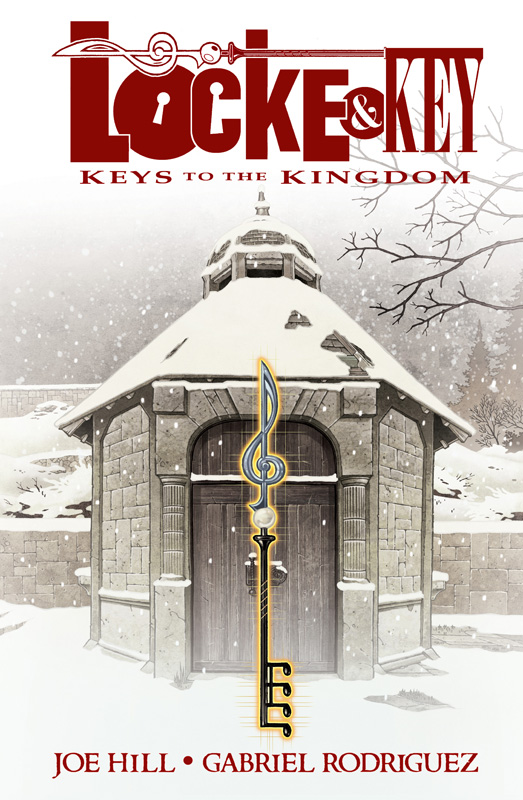
Locke and Key Volume 4 Keys to the Kingdom Joe Hill Gabriel Rodriguez IDW Comics[xrr rating=5/5]

The Low-Down: The fourth collection of Joe Hill and Gabriel Rodriguez’s dark fantasy is the best yet – a pitch-perfect example of horror storytelling combined with inventive concepts, brilliant characterisation and yet more jaw-dropping artwork.

What’s it About?: Their father was murdered, and the Locke children have returned with their mother to the old family home of Keyhouse. There, they’ve discovered a whole collection of magical keys with bizarre and unearthly powers – and they’ve also come under threat from the creature that used to be trapped in the Keyhouse well. Unfortunately, they don’t know that the creature is now posing as their school friend Zack Wells, who’s starting to lose patience in his quest to find the mysterious Omega Key…

The Story: Ah, expectations can be a killer. Tell a longtime comics fan that his favourite series’ next six-issue outing will consist of four one-part stories and a two-parter, and disappointment will almost immediately set in. Modern-day mainstream comics (especially superhero stories) often seem structured more as six monthly chunks of the final graphic novel than instalments in their own right, and often don’t even work on their own terms as a single instalment. Single issue stories – they’re supposed to be the exception, not the rule. Aren’t they?

However, Locke and Key is a different matter. Ever since volume 2, Head Games, the series has placed just as much emphasis on the character-centric single issue stories as on the bigger, pacier tales (like the three-part Crown of Shadows adventure in volume 3), and while volume 4 does mainly consist of character-driven single done-in-one stories, this is a long way from being filler – in fact, it’s the most inventive and adventurous collection of Locke and Key to date, advancing the story in a number of critical ways, giving us a whole selection of new keys, all while building up to a shocking climax and a mother of a cliffhanger.

Locke and Key Volume 4 Keys to the Kingdom Joe Hill Gabriel Rodriguez IDW Comics Issue 3 Cover 'February'A tremendously skilled writer, Hill continues to serve up outstanding characterisation, adding nuances to character with carefully chosen details, and paying off emotional plotlines with massively affecting consequences. Of course, to anyone who’s read his fiction this is no surprise (Hill’s second novel, Horns, remains the only novel I’ve ever given up on part-way through simply because I knew it was going to upset me too much), but one of the most impressive things about Locke and Key is that, unlike some novelists who end up writing comics (and who often end up producing fine work), Hill really does understand how comics work as a medium, and that they let you do things you simply can’t do anywhere else.

There are points in Keys to the Kingdom where Hill cuts loose with a more daring and experimental approach (from the brilliantly compressed storytelling of ‘February’ to the wonderful and utterly unexpected Calvin and Hobbes homage in ‘Sparrow’), all the while understanding when to let the visuals tell the story. Locke and Key is a comic with a really distinctive identity, and the tonal shifts between off-beat dark children’s fantasy and outright horror just get more and more effective and disturbing. Indeed, it’s incredible exactly how much plot Hill manages to cram into these six issues, while he also gradually cranks the tension up to almost unbearable levels and shows no compunction in going for genuinely horrific violence when it’s required.

Hill’s already declared that Locke and Key will be ending in twelve issues, and the first issue of the fifth miniseries ‘Clockworks’ will be appearing in comic book stores soon – but while the story may be heading towards it’s end, it’s obvious there are plenty of shocks and surprises to come. The long-awaited TV adaptation may have failed to get beyond its unaired (and highly acclaimed) pilot episode, but Locke and Key remains one of the most well-crafted and compulsively readable comic books currently being released.

Locke and Key Volume 4 Keys to the Kingdom Joe Hill Gabriel Rodriguez IDW Comics Issue 2 Incentive Cover 'White'The Art: He started strong, and has been getting better and better through every series, but Keys to the Kingdom sees Gabriel Rodriguez go even further than before. His controlled, cartoony yet distinctive style is still as sharp as ever, as is his design work (virtually every one of the Keyhouse keys is a genuine work of art), but here he also takes on some serious challenges, whether it’s the brilliant war comic homages in chapter four, or the daring and wonderful Bill Watterson homage in chapter 1. Each one of these he pulls off with a major amount of style, while also matching Hill’s script in terms of portraying the character’s emotions (especially in the wonderful third chapter). Combined with Jay Fotos’ gorgeously creative and subtle colour work, and Locke and Key remains a seriously good-looking bit of comic art.

The Verdict: If you like dark fantasy or horror, and you’re not reading Locke and Key, get a move on and catch up with the story so far – you won’t be disappointed. One of the best comic series currently being published is going from strength to strength, and looks to be powering its way towards one hell of an ending.

[amtap book:isbn=1600108865]